Ask AI to recommend a GEO agency: how to check the answer
An AI answer can give you a shortlist in minutes. The useful work starts when you open its sources. Does a link support the sentence beside it? Who wrote the source? Is a service description being treated as proof of results?
We asked ChatGPT, Claude and Grok the same question on 22 October 2026. This walkthrough shows what we captured and how we checked selected claims. It is not a ranking of engines or agencies. For the broader buying decision, use our GEO agency selection scorecard.
Disclosure: Auden is a new GEO provider building its website and public evidence. No included answer named Auden. That is a starting observation, not a verdict on the business or a failure of this exercise. It describes these answers only; it does not measure public visibility or what another person will see.
The question and the conditions
Recommend a GEO agency for a US business. What criteria and evidence should I use to choose one? Cite sources where available.
We sent the wording above without adding Auden, a preferred supplier, an industry or a budget. We did not follow up to obtain a more favorable recommendation. “US business” was part of the question; it does not establish that the accounts or search results were located in the United States.
| Product | Visible mode | Conditions and saved time, UTC |
|---|---|---|
| ChatGPT | Chat; Pro. Specific model not shown. | Signed in, fresh conversation, not temporary. Web search and research activity were visible. Saved 06:08. |
| Grok | Fast | Signed in, fresh conversation, not private mode. Four searches were shown during the response. Saved 05:58. |
| Claude | Opus 5.5 Medium; Auto | Per-conversation incognito. Four web searches shown. Prompt sent 06:02; completed text saved 06:08. |
These are different product modes, not controlled equivalent configurations. Location, VPN state and account personalization were not independently established. ChatGPT and Grok used accounts with prior related use. We did not change persistent account settings.
One excluded attempt: our first Claude answer, in a fresh signed-in conversation outside the project, visibly drew on prior account context. We kept it internally and excluded its text and screenshot from this article. We then made one replacement in Claude’s incognito conversation mode. The interface said that mode used no history or memory. This is four attempts in total, three included answers—not three perfectly matched tests.
What the answers actually did
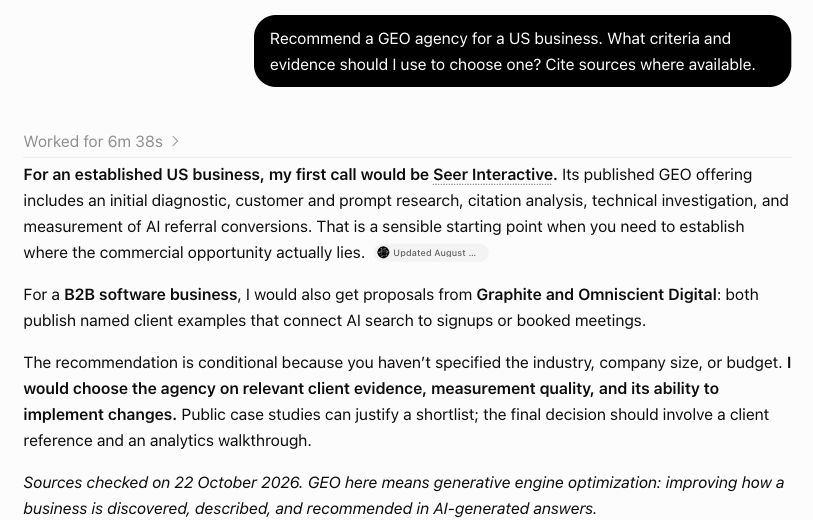
ChatGPT gave a conditional shortlist
The answer led with Seer Interactive for an established US business. It also discussed Graphite, Omniscient Digital and Siege Media for different needs. It explicitly said the recommendation depended on missing business details and separated public case studies from independently audited performance. These are descriptions of the captured answer, not Auden’s endorsements.
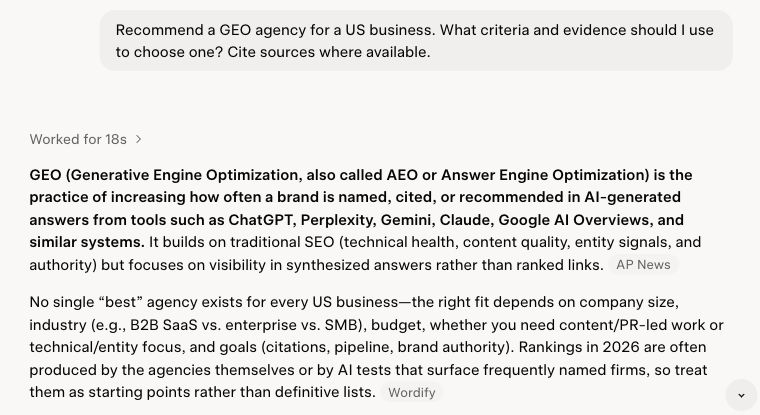
Grok named several possible providers
Grok’s answer suggested different providers for content, technical and full-service needs. Its named examples included First Page Sage, Siege Media, Omniscient Digital, iPullRank, WebFX and Go Fish Digital. It also discussed other firms. It warned that agency rankings can be self-interested and asked the reader to verify current offers.
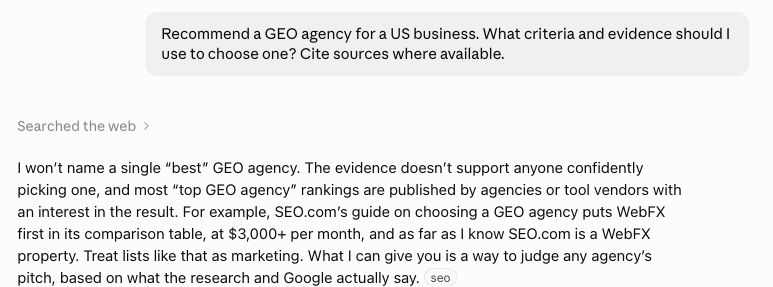
Claude did not select a single winner
The incognito Claude answer declined to name one best agency and focused on how to evaluate a proposal. It discussed SEO.com’s comparison as an example and linked to research commentary and buying guides. We did not ask it again to force a shortlist. An answer that does not give the requested winner is still a result worth keeping.
Four source checks you can repeat
We opened the distinct inline citation destinations available in the included answers. Across the three included answers there were 29 distinct inline destinations, counting within each answer. Retrieval succeeded for 24; five could not be fetched by our checking tool: AP News and GetGeology in Grok, plus SEO.com, Practical Ecommerce and the LinkedIn profile in Claude. Retrieval is not factual verification. The examples below are a selected claim audit, not a complete factual review of all three answers. “Not checked” means we could not establish support; it does not mean the source is false.
1. A service page can support scope, not superiority
ChatGPT linked its opening Seer recommendation to Seer’s own GEO service page. The page describes a diagnostic phase, prompt development and tracking, and AI-driven traffic conversion analysis. That supports the narrow statement that the provider describes those services.
It does not, by itself, prove that Seer is the best choice for your business or that a promised outcome will happen. Write two separate notes: “service described by provider” and “results still to verify.” Then ask for a relevant example, the underlying measurements and a current scope. Do not turn a matching service description into an audited performance claim.
2. Check who owns a comparison list
Grok cited Wordify’s agency comparison. When checked on 22 October 2026, its title referred to 2027 while its displayed update date was 9 October 2026. Wordify disclosed that it was included in its own list, in sixth position. It also said that none of the agencies it reviewed published all of the prompt, assistant and cited-page evidence it wanted to see together.
Those details change how to read the link. The page is an agency’s comparison with a disclosed interest and stated evidence limits. The year in a headline does not replace checking the update date. We have not independently established every assessment in that list.
Another Grok citation led to First Page Sage’s AI search optimization list. That exact page displayed 19 October 2026 and placed First Page Sage first. A separate GEO-list URL is a different document. Record the exact link you opened; similar titles on the same site are not interchangeable evidence.
3. A recognizable publisher label is not enough
Grok showed an AP News label linked to a URL in a press-release path. Our source-checking tool could not retrieve that destination. We therefore left the attached claims unverified. We did not treat the label as proof of AP newsroom endorsement or claim that the page was broken for everyone.
The incognito Claude answer attached a research-summary citation label to a LinkedIn profile URL. Our tool could not retrieve that profile either. A reader should seek the original study before relying on the statistic. We do not repeat that statistic here as an established finding. Follow the actual destination, not just the words displayed on the citation chip.
4. Follow technical advice to the platform’s own documentation
ChatGPT directly cited Google’s guide to its generative AI search features. The document says Google Search does not use llms.txt and does not require special content chunking or a particular AI-writing style. It also cautions against making pages for every wording variation primarily to manipulate rankings or AI responses.
This supports advice about Google Search, including its AI features. It does not establish what every other assistant uses. When an agency proposes a technical change, ask which system it is meant for and where that system documents the requirement. Keep the scope of the conclusion as narrow as the source.
| Answer and claim assessed | Exact source | Source type | Judgment |
|---|---|---|---|
| ChatGPT: Seer describes a diagnostic and measurement offer. | Seer GEO service page | Provider-owned service description | Supported for stated scope; superiority and outcomes not assessed. |
| Grok: an agency’s published list supports its named positioning for First Page Sage. | First Page Sage AI-search list | Agency-owned comparison ranking itself first | Partly supported: the list states that positioning; independent superiority is not established. |
| Grok: its opening GEO description cites an AP News-labelled destination. | Exact cited press-release-path URL | Contents not retrieved; URL indicates press-release path | Not checked. Retrieval failed in our tool. |
| Claude: its answer discusses SEO.com’s comparison, price and ownership. | SEO.com cited guide | Contents not retrieved | Not checked. No ownership or price conclusion adopted. |
| ChatGPT: Google Search does not require llms.txt or special content chunking. | Google’s AI optimization guide | Official platform documentation | Supported for Google Search; not generalized to all engines. |
Why source counts need labels
We recorded 12 distinct inline URLs in the ChatGPT answer, 10 in Grok and 7 in the incognito Claude answer. Repeated links were counted once within each answer. These are links shown inside the answer, not unique websites crawled, not all underlying search results and not quality scores.
Grok separately displayed “35 sources.” We did not audit that drawer as a separate source set and do not substitute its counter for the 10 inline destinations. Claude also grouped some citations behind “+3” labels. Those additional grouped destinations were not part of our inline count. The counts therefore describe exactly what we extracted, not everything an engine may have consulted.
From the first question to a buying decision
Our captured journey has two observed stages: a broad agency question, followed by opening sources and checking selected claims. We did not capture a buyer making a purchase, a two-week journey or follow-up answers about a final shortlist.
The next stages below are a proposed research plan, not recorded events. A buyer can narrow the brief to their industry, budget and delivery needs; compare two or three providers against the same evidence requirements; and validate the proposed scope with the people doing the work. A useful follow-up question would be: “Which evidence is still missing before I can compare these providers?” Save the actual response if you run it, including uncertainty and sources.
For a new provider such as Auden, the same process gives a practical content agenda. Can a reader find a clear service scope, responsibilities, terms and examples they can check? If a source is missing, record the gap and build the underlying evidence before claiming results. Then repeat a defined set of questions under recorded conditions on later dates. Compare mentions, citations and linked pages separately from visits or enquiries. Changes may have several causes; adding a page does not guarantee a recommendation or a first-page ranking.
Try the check yourself
- Write the decision first. Include your real market, business type and budget when you want a useful shortlist. Keep the wording unchanged when comparing samples.
- Record the conditions. Save the date, visible mode, search activity and whether the conversation is temporary. Do not call a fresh conversation context-free without evidence.
- Save the whole answer. Keep refusals, missing citations and non-mentions. Screenshots in a public article may be excerpts; your working record should not be.
- Open the important links. Start with claims about price, scope, results and technical requirements. Note the exact URL, publisher and date.
- Match claim to evidence. Use “supported,” “partly supported,” “contradicted” or “not checked,” and explain why. A fetch failure belongs in the last group.
- Ask the provider for the missing proof. Use the selection scorecard and shortlist worksheet to turn your notes into comparable questions.
A simple record is enough: question; product and mode; time; account conditions; answer; citation URL; exact claim checked; source type; support judgment; open question. Repeat on another day before interpreting patterns. This article did not perform that repeatability test.
A historical diagnostic is a different kind of evidence
The image below is a saved diagnostic of Auden’s own homepage reopened on 22 October. It was produced in the local Mimic Bot team demo and assessed one source page before the 22 October Services and homepage restructure. The report’s original creation date is not established here. It is not a fresh assessment of today’s site. Its 7.4/10 is a score under that tool’s rubric, with 75% evidence coverage. The screen itself labels 10/10 as a conditional target that has not been earned.
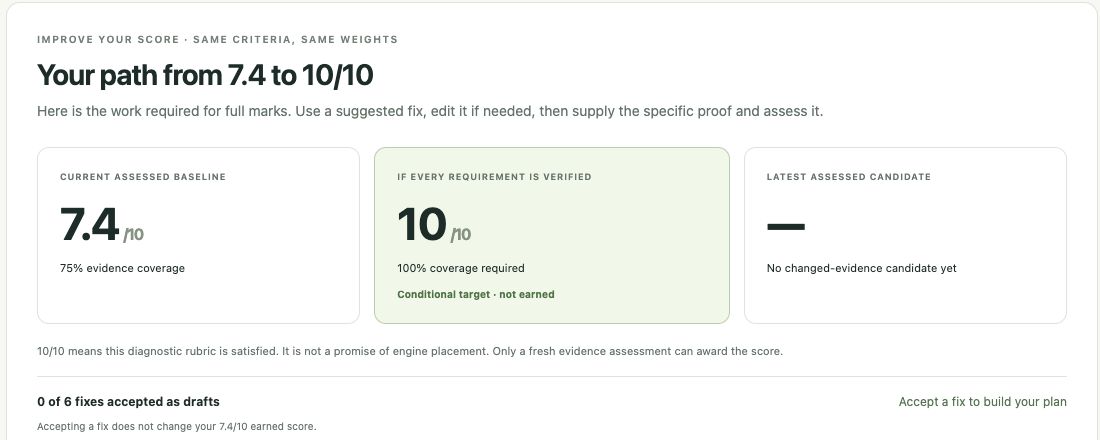
Use the distinction when reviewing an agency’s report. A rubric can identify missing facts on a page. A captured assistant answer shows what appeared in one conversation. Analytics can show visits and actions. None of those records automatically proves the other two.
What this walkthrough cannot tell you
One included answer per product cannot estimate recommendation frequency, compare engine quality or show what US buyers generally see. The modes and account conditions differ. We have not verified every agency claim, research statistic, hidden citation group or search result. No client conversion, revenue lift or ranking improvement was measured.
The value is the checking process: read the answer, open the source, narrow the claim and write down what remains unknown. For definitions and the difference between observations and business results, read our GEO and AEO buyer guide. For our own scope and terms, see Auden’s GEO services and apply the same checks.