Playbook
What should your next GEO investment fix?
A chart about GEO tactics caught my attention. It compared the effort involved with the business impact people reported. That is a useful question to ask before adding another project to the marketing calendar.
But a chart cannot see your website.
Your strongest service page might be inaccessible to search. It might be perfectly accessible but say little that helps a buyer. Or it might contain useful evidence that nobody outside your company has a reason to reference.
Those are different problems. They deserve different budgets.
For generative engine optimization, I would start with a simpler question: what is stopping a relevant buyer from finding, understanding and trusting our answer?
Start with one buying decision
Choose a real question your team encounters. For a US commercial HVAC contractor, that might be: “What should a facilities manager check before choosing a preventive maintenance agreement?”
This is a hypothetical example, not an Auden client result. It gives the work a useful boundary: one buyer, one decision and one page to inspect. “Improve our AI visibility” is much harder to turn into an accountable piece of work.
Then use the following gates. Stop at the first material problem and define a fix. The sequence is an editorial decision aid, not a ranking formula; work can overlap when different people own it.
Auden / GEO priorities
Find the gap before you fund the tactic.
One buyer question. One relevant page.
- AccessCan the search system reach the page?Resolve unintended access problems.
- UsefulnessCan a buyer make a better decision?Answer the question. Explain the limits.
- EvidenceCan you support the important claims?Add reviewed expertise, examples or data.
- DistributionWho has a reason to reference this work?Find the relevant audience and purpose.
Fix the first material gap. Recheck.
Measure citations, recommendations and business outcomes separately.
A planning aid. No ranking or ROI promise.
1. Can the intended search system access the page?
Ask your web team to inspect the actual page, its indexing settings, internal links and hosting restrictions. A working page in your browser is a useful start, but it does not establish that a search system can retrieve and use it.
Google says a page must be indexed and eligible for a search snippet to appear as a supporting link in AI Overviews or AI Mode. Meeting its requirements does not guarantee inclusion.
For ChatGPT, OpenAI distinguishes OAI-SearchBot from GPTBot. Search access and training access are separate controls. Review the intended access rather than broadly changing every bot rule.
If the relevant page has an unintended block, resolving that deserves attention before polishing its introduction. If access is already sound, more technical work needs a specific reason. “Technical SEO” is not a permanent first-place budget category.
2. Does the page actually help someone decide?
Our hypothetical contractor’s page begins with “comprehensive, industry-leading solutions.” A facilities manager still cannot tell what the agreement includes.
A useful refresh would explain inspection scope, exclusions, emergency-call arrangements, service area and what information is needed for a quote. Put the direct answer near the top, then explain the conditions and exceptions. Do not promise an attendance time the operations team cannot deliver.
This is where concise summaries and sensible headings help: they make a substantive answer easier to use. They cannot supply missing substance.
Google’s current guidance emphasizes useful, original contributions and firsthand experience. It also says there is no special schema markup required for generative AI search. Accurate structured data can still serve relevant search features; a blanket “AI schema” project needs a clearer purpose.
3. What supports the answer?
Ask the person who does the work what buyers routinely misunderstand. An experienced technician could explain why two apparently similar maintenance agreements cover different equipment checks. A reviewed example and a clear explanation may be more useful than a broad article assembled from other websites.
Original research is another option, but it carries a different workload. Someone must define the question, collect suitable observations, check permission to publish, explain the method and maintain the result. Existing business data is not automatically representative of the market.
If the contractor publishes an anonymized analysis of its own maintenance visits, it should state the period, sample, exclusions and limits. It should not turn that sample into a national failure-rate claim.
AI can help organize notes or draft a comparison table. A person with relevant knowledge still needs to check every claim. Count that review time, along with design and maintenance, when estimating effort.
4. Who has a reason to reference this work?
Once the page is useful and defensible, consider distribution. Could an industry publication use the finding? Would a relevant professional association find the checklist helpful? Are existing business profiles accurate?
Digital PR and third-party coverage are possible projects here, with their own editorial and relationship costs. They are not guaranteed routes to an AI recommendation. A page can be cited as evidence without its company being recommended as a supplier.
The test for outreach is whether there is something worth sharing with that audience. Buying a collection of vague mentions does not solve a weak answer.
Give the next piece of work a clear finish line
For the contractor, the next assignment might be: “Replace the vague agreement page with an operations-reviewed scope comparison, publish the exclusions and check that the page is accessible.” That is a concrete deliverable. “Publish ten GEO articles” is an output target without the same connection to the buyer’s problem.
Estimate effort with the people doing the work. Include dependencies, approvals, specialist review and future updates. A short page with difficult evidence can take longer than a long page with easy claims.
Before changing it, save a baseline. Keep a small set of relevant questions, the answers and source links, and the product, date, search mode and location used. Repeat under comparable conditions; fresh conversations alone do not remove personalization.
Keep the outcomes separate:
- Access and retrieval: could the system obtain the information? Log only what your evidence establishes.
- Citation: did it reference the page?
- Recommendation: did it suggest the company for the buyer’s need?
- Business outcome: did an identifiable visit become a qualified inquiry or sale?
Use available reporting within its limits. Google’s Generative AI performance report provides impression reporting for AI Overviews and AI Mode; impressions are not conversions. Bing’s AI Performance reporting records citation activity across supported experiences, which does not establish a page’s ranking or endorsement. Neither is a universal report of every AI assistant.
Allow for discovery time and changing systems. A favorable answer after an edit is an observation, not proof that the edit caused it.
If you are choosing a starting topic, our article on ChatGPT’s emailed prompts as a research signal offers another way to notice relevant tasks. For the broader buying context, see our GEO and AEO buyer guide.
Spend the next hour identifying the missing piece. Then fund the work that fixes it. The best next step depends on what your buyer needs and what your page currently fails to provide.
Inspiration note: an NP Digital infographic shared with us compares perceived impact and effort for GEO tactics. Its footnote attributes the scores to a September 2026 survey. We have not independently verified its full methodology, and have not reproduced its scores or treated them as measured ROI. The decision flow and HVAC examples here are original proposed practice, not survey findings or client results. Reviewed 26 October 2026.
Keep reading
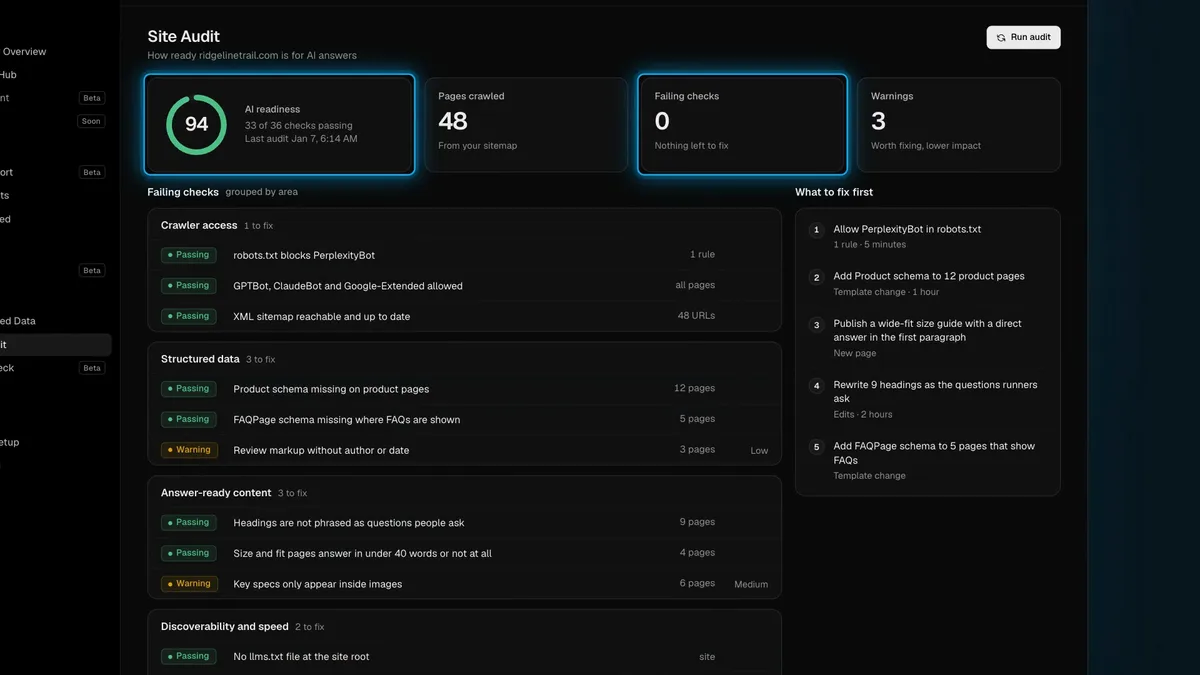 Playbook
The Click After the Citation: Is Your Page Ready for an AI-Referred Visitor?
A citation can lead someone to your page. Does the page help them finish the task? Use these four checks to review the answer, supporting detail and next step.
5 min read
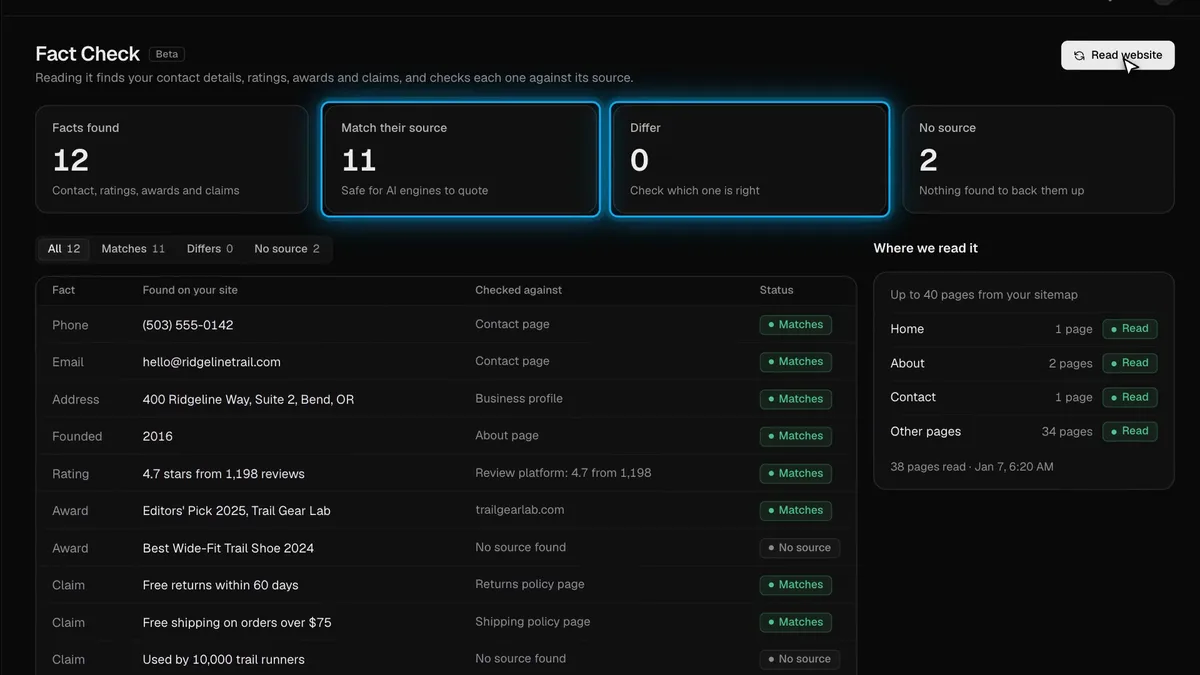 Playbook
AI Knows Your Brand. Does It Have the Facts Right?
Showing up in AI answers is one question. Being described correctly is another. Here's a repeatable way to log what AI says about your brand, label each claim against verified facts, and correct the sources you can reach.
6 min read
 Research
Could ChatGPT’s emailed prompts help you decide what to publish?
A prompt in an OpenAI newsletter can reveal a useful customer task. It does not prove demand or guarantee a recommendation. Here is how to turn the observation into a small, honest content test.
6 min read