GEO guides · Fundamentals
What is GEO (generative engine optimization)?
GEO, short for generative engine optimization, is the work of making a business easy for AI assistants to find, understand, cite and describe correctly. It sits on top of SEO. Google says optimizing for AI search is treated as SEO and that its AI features have no extra technical requirements.1
Last updated November 16, 2026 · By Auden editorial team · 5 min read
Key takeaways
- GEO is about whether an AI answer names your brand and links to your site as a source.
- It builds on SEO. Google lists no extra technical requirements for its AI features beyond being indexed and eligible for a snippet.2
- The work has five jobs: crawler access, answer-first pages, structured data, measurement and correcting wrong answers.
- No one controls what an assistant says. Good GEO improves the inputs and measures the outputs.
What is GEO?
GEO, or generative engine optimization, is the practice of making a business easy for AI assistants to read, understand, cite and describe correctly. The goal is that an assistant names your brand in its answer and links to your site as a source when a buyer asks a question you should be answering.
AEO stands for answer engine optimization. It means making your information useful when someone asks a question. GEO stands for generative engine optimization. It means working on how your business appears in AI answers. The two terms describe overlapping work, and this guide uses GEO for both. The glossary defines the other terms used across these guides.
The place this work shows up is an AI answer: the summary above Google results, the reply in ChatGPT, Claude or Perplexity, the response in Microsoft Copilot. Each of those can name brands in the text and list the pages it relied on.
How is GEO different from SEO?
SEO helps search engines understand your pages and helps people find them. It is measured in clicks and position. GEO adds a second goal: getting your brand named in an AI answer and your site cited as the source. It is measured in mentions, citations and share of voice.
| SEO | GEO | |
|---|---|---|
| What the buyer sees | A list of links | One written answer, usually with sources |
| Wins with | Keywords, backlinks, page rankings | Clear facts, structured content, trusted mentions across the web |
| Measured in | Clicks and position | Mentions, citations, share of voice |
Google describes it from its side. It says that to appear as a supporting link in AI Overviews or AI Mode a page must be indexed and eligible to show in Search with a snippet, and that there are no additional requirements.2 It also says it treats optimizing for generative AI search as SEO.1 Auden reads that as a reason to treat the two as one program: pages that are crawlable, indexed and clear are the base, and GEO adds the checking of what the answers actually say. See GEO vs SEO for the longer comparison.

What does GEO work involve?
GEO work falls into five jobs: letting the right crawlers in, publishing pages that answer buyer questions directly, marking pages up so they are unambiguous, measuring where you appear, and correcting what assistants get wrong. Each job has its own guide on this site.
- Crawler access. OpenAI, Anthropic and Perplexity each publish separate crawlers for search, training and user-requested fetches.34 See AI crawlers and robots.txt.
- Answer-first pages. Google advises original content that reflects first-hand experience, organized with clear headings.1 Microsoft recommends clear headings, tables and FAQ sections.5
- Structured data. It labels what a page is. See structured data for AI search.
- Measurement. See measuring AI search traffic and prompt tracking.
- Corrections. See fixing wrong AI answers.
What does Google say you need for its AI features?
Google says a page must be indexed and eligible to be shown in Google Search with a snippet to appear as a supporting link in AI Overviews or AI Mode. It lists no additional technical requirements and says you do not need special markup or AI text files. It adds that indexing and serving are not assured.2
Google also says you do not need llms.txt, AI-specific markup or Markdown copies of your pages for Search, and that there is no ideal page length.1 It advises against generating large numbers of pages for query variations, which it says violates its scaled content abuse policy.1 That is why this hub holds a small number of guides that each answer a different question.
Other engines document their own mechanics, and the guides on how assistants choose answers and each engine go through them.
How do you know whether GEO is working?
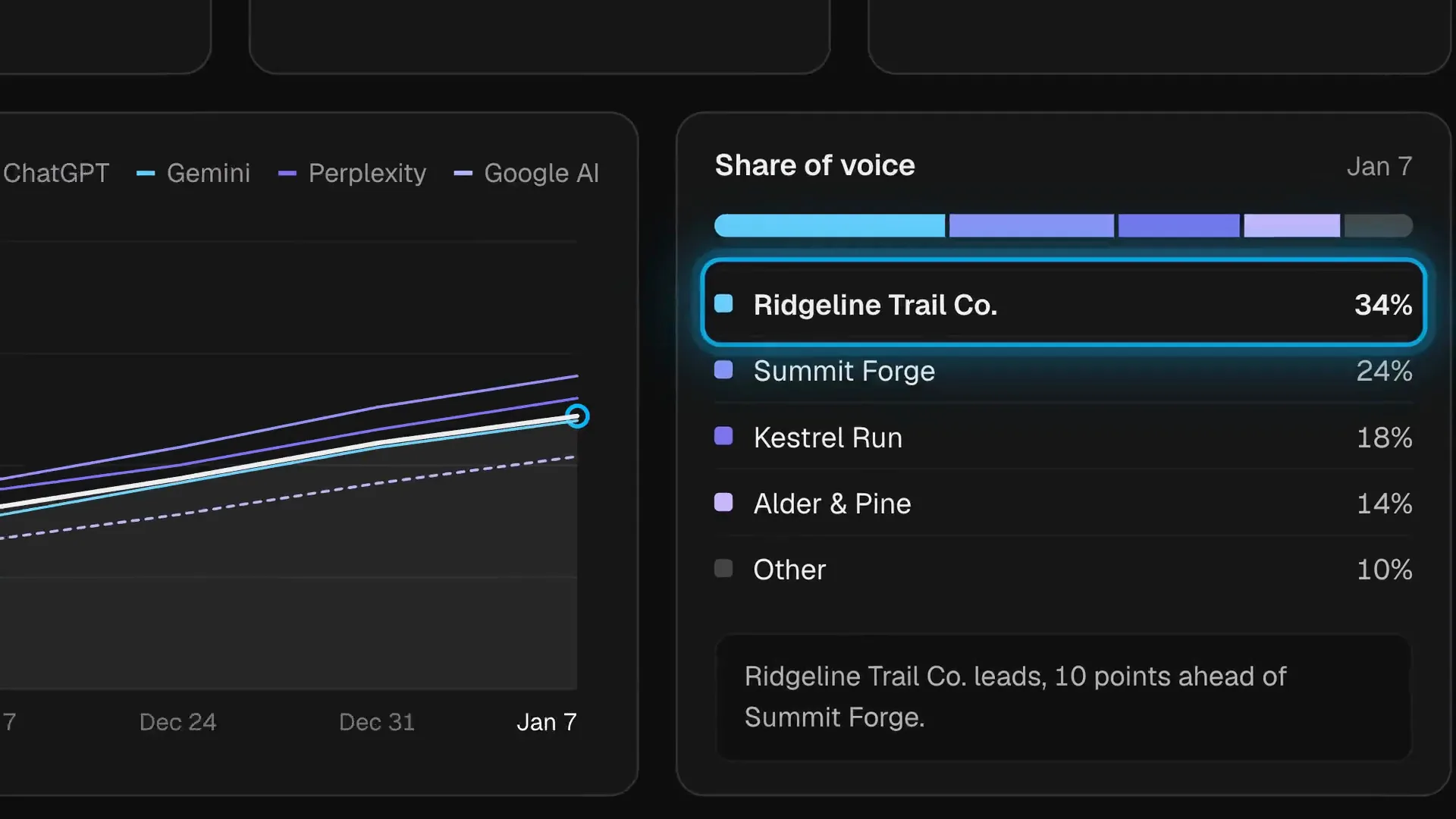
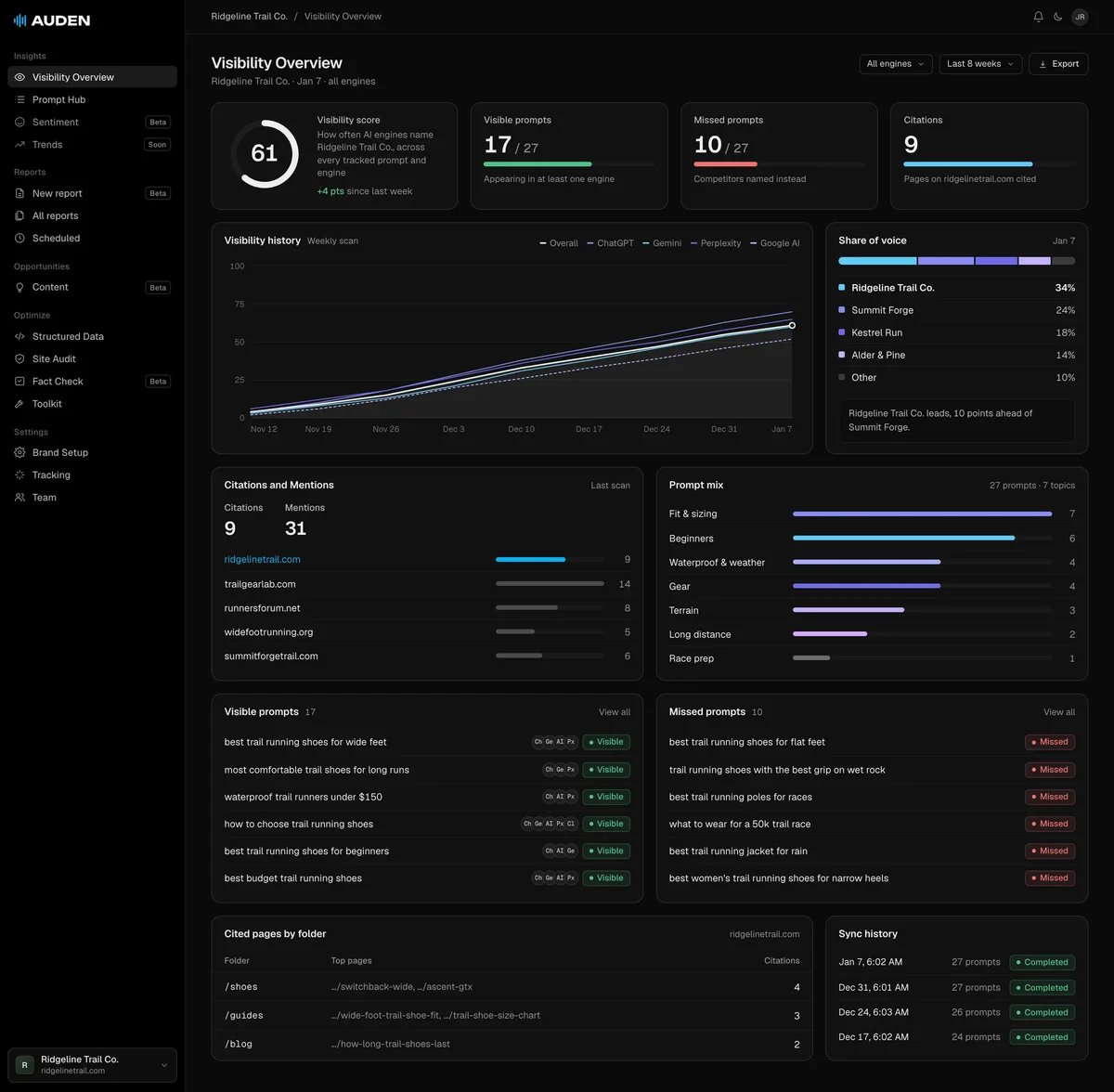
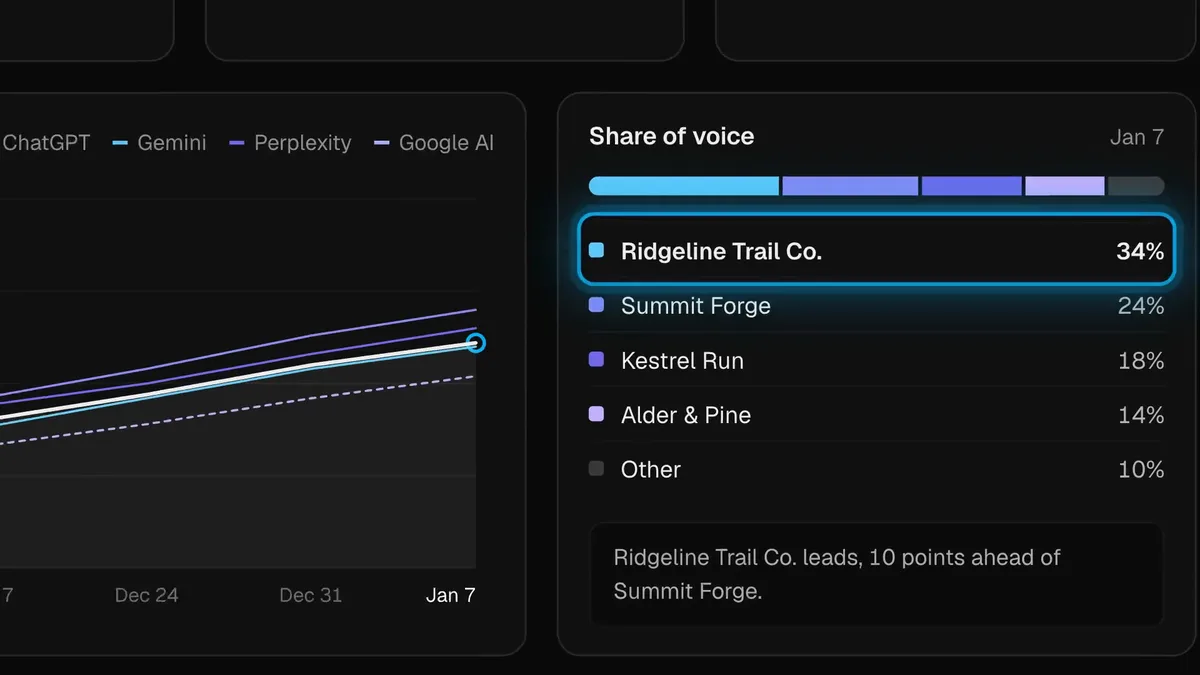
Track whether AI answers to your buyers’ questions name your brand, cite your pages and describe you accurately, then compare over time. Google Search Console and Bing Webmaster Tools now report some AI impressions and citations, and a fixed set of prompts that you run yourself covers the rest.
Search Console’s generative AI performance report counts impressions of your links inside Google’s AI Overviews and AI Mode.6 Bing’s AI Performance report counts citations in Microsoft Copilot and in AI-generated summaries in Bing.5 Neither says whether you were recommended, which is why prompt tracking exists.
Results arrive on the engines’ schedules. Google says crawling can take a few days to a few weeks after you request it, and a request does not mean inclusion.7
Questions people ask
Is GEO the same as AEO?
The two terms describe overlapping work. AEO means making your information useful when someone asks a question, and GEO means working on how your business appears in AI answers. Auden uses GEO for both.
Does GEO replace SEO?
No. Google says a page must be indexed and eligible to show in Search with a snippet to appear as a supporting link in its AI features, so SEO fundamentals remain the base.2
Can anyone promise that an assistant will name my business?
No. Assistants choose what to say for each question, and Google says indexing and serving are not assured.2 Work on your pages and access improves the inputs, and measurement shows the result.
Do I need an llms.txt file?
Google says Search does not use llms.txt, and that creating one neither helps nor harms Search visibility.1 The llms.txt guide covers when it is still worth publishing.
How long does GEO work take to show up?
It depends on how fast each engine recrawls your pages. Google’s recrawl guidance puts crawling at days to weeks.7
Sources
Every statement about how an engine, crawler, file or schema works comes from the pages below, which we read on November 16, 2026. Vendors change these pages, so check the originals before you act.
- 1Google Search CentralOptimizing your website for generative AI features on Google Searchdevelopers.google.com/search/docs/fundamentals/ai-optimization-guide · accessed November 16, 2026
- 2Google Search CentralAI features and your websitedevelopers.google.com/search/docs/appearance/ai-features · accessed November 16, 2026
- 3OpenAI DevelopersOverview of OpenAI crawlers (OAI-SearchBot, GPTBot, ChatGPT-User)developers.openai.com/api/docs/bots · accessed November 16, 2026
- 4Anthropic Privacy CenterDoes Anthropic crawl data from the web, and how can site owners block the crawler?privacy.claude.com/en/articles/8896518-does-anthropic-crawl-data-from-the-web-and-how-can-site-owners-block-the-crawler · accessed November 16, 2026
- 5Bing Webmaster BlogIntroducing AI Performance in Bing Webmaster Tools Public Preview (February 10, 2026)blogs.bing.com/webmaster/February-2026/Introducing-AI-Performance-in-Bing-Webmaster-Tools-Public-Preview · accessed November 16, 2026
- 6Search Console HelpGenerative AI performance report (Search)support.google.com/webmasters/answer/16984139 · accessed November 16, 2026
- 7Google Search CentralAsk Google to recrawl your URLsdevelopers.google.com/search/docs/crawling-indexing/ask-google-to-recrawl · accessed November 16, 2026
Related guides
 How AI assistants choose answersWhen assistants search, how one question becomes several searches, and what makes a page eligible to be cited.5 min readUpdated November 16, 2026
 Citations vs recommendationsWhy a page can be cited while a competitor is named, and how to measure each outcome separately.5 min readUpdated November 16, 2026
 Measuring AI search trafficWhat Google Search Console and Bing Webmaster Tools report, what server logs show, and what none of it tells you.4 min readUpdated November 16, 2026
See how AI answers describe your business today.
Auden is a GEO service for US businesses. Run the free visibility check, or talk to the team about a plan.