GEO guides · Engines
How does Claude use web search and cite sources?
Claude searches the web when a question benefits from current information, and Anthropic says every response that uses search includes citations. Anthropic runs three crawlers with different jobs: Claude-SearchBot for search quality, Claude-User for user requests and ClaudeBot for training. Each can be managed in robots.txt.13
Last updated November 16, 2026 · By Auden editorial team · 4 min read

Key takeaways
- Claude decides when to search. For stable knowledge it answers directly.2
- Web search responses include citations, source links and sometimes quotes.1
- Disabling Claude-SearchBot or Claude-User may reduce your visibility in Claude. ClaudeBot relates to training.3
- Presence also depends on customer settings: organization owners enable web search, and admins and developers can restrict domains.12
When does Claude search the web?
Claude searches for requests that rely on current or changing information, or on anything outside its training data. Examples are recent news, current prices, and specifics about organizations and products that may have changed. It answers directly for stable knowledge. On claude.ai there is no toggle in the new experience, and Claude searches when it helps.21
For a business, questions that name a company, a product or a price are the likely triggers, because those are things that may have changed. Stable background explanations can be answered from training with no search at all, and then there are no citations to read.2
Adding “Search the web” or “Use web search” to a prompt makes Claude search, and you can tell it not to. That is useful when you test how Claude describes your business. Anthropic also says Claude may use an approximate location inferred from your IP address for localized results.1
How does Claude cite sources?
Anthropic says every response from Claude with web search includes citations so you can verify sources. The help center lists direct citations, source links for further reading and relevant quotes where appropriate. In the API, citations are always enabled for web search and carry the source URL, the title and up to 150 characters of cited text.
The API also returns each result’s page age, described as when the site was last updated, and Anthropic says developers must show citations to the original source when displaying output to end users.2 When web search is on, Claude can also fetch the content of specific URLs a user provides.1
When you read a Claude answer, open each cited link and compare the quoted text with the page. The API’s cited text is limited to 150 characters, so a quote is an excerpt and may sit inside a longer passage.2

Which Anthropic crawlers should you manage?
Anthropic documents three. ClaudeBot collects content for model training. Claude-User supports users when they ask Claude questions, and disabling it prevents retrieval of your content for user queries. Claude-SearchBot improves search result quality, and disabling it stops indexing for search. Anthropic says its bots honor robots.txt.3
| Crawler | Purpose | If you disable it |
|---|---|---|
| Claude-SearchBot | Improves search result quality | Content is not indexed for search, which may reduce visibility and accuracy. |
| Claude-User | Handles user-initiated requests | Retrieval for user queries stops, which may reduce visibility in user-directed search. |
| ClaudeBot | Collects content for model training | Signals that your future material should be excluded from training sets. |
Anthropic also supports the non-standard Crawl-delay directive, says its bots do not bypass CAPTCHAs, and publishes crawler IP ranges at claude.com/crawling/bots.json. It warns that blocking those IPs may not reliably opt you out, because the bots then cannot read robots.txt.3
Who else controls whether your site appears?
Claude customers do, through their own settings. On Team and Enterprise plans an Owner must enable web search for the organization. In the Claude Console, administrators can disable web search or restrict which domains it searches. Developers using the API can set allowed or blocked domains on the search tool.12
The effect is that you can do everything right on your side and still be absent from a given company’s Claude, because that organization excluded or restricted search. When you measure, treat it as one reason an answer may not cite you.
What should you do?
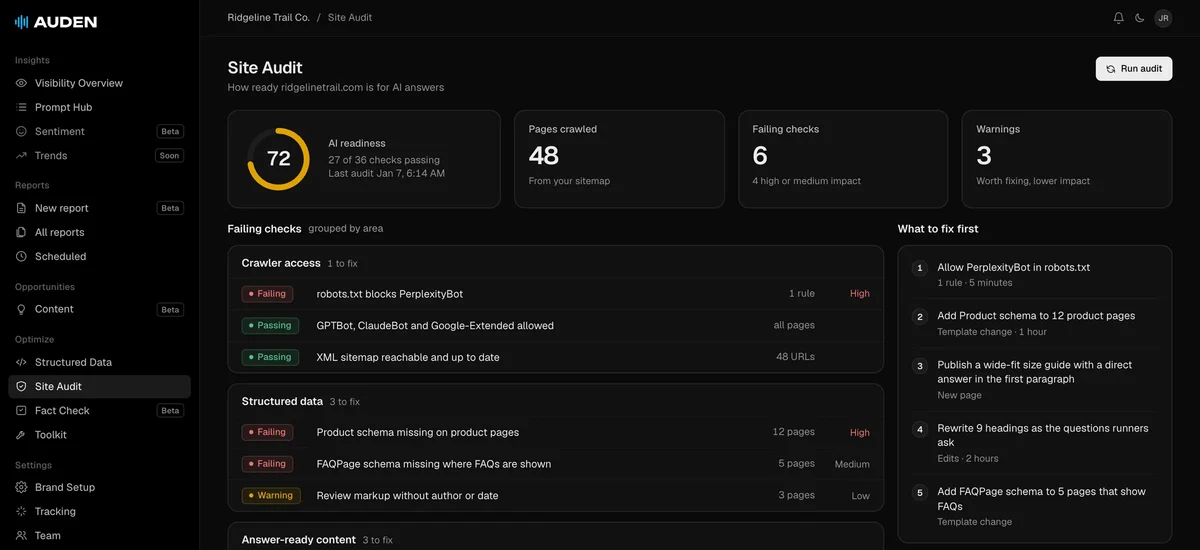
Decide which of the three crawlers you want to allow, write explicit groups for them, check your firewall, then test with search switched on. Record whether Claude searched, which sources it cited and whether it described you correctly. Repeat after each change to your pages or robots.txt.
- Allow Claude-SearchBot and Claude-User if you want to be visible in Claude’s search answers. Decide ClaudeBot separately.
- Confirm no broad
User-agent: *rule contradicts your choices.4 - Check the firewall against Anthropic’s published IP list.3
- Run your buyer prompts in Claude with web search on, using “Search the web” where needed.1
- Log the answer, the citations and the date, as described in prompt tracking.
Questions people ask
Does Claude always search the web?
No. It answers directly for stable knowledge and searches for current or changing information.2
Does blocking ClaudeBot stop Claude citing my site?
ClaudeBot collects content for training. Search and user retrieval are handled by Claude-SearchBot and Claude-User, which have their own settings.3
How do I make Claude search when I test?
Include “Search the web” or “Use web search” in the prompt.1
Does Claude show where its information came from?
Anthropic says every response that uses web search includes citations.1
Is there a new AI training signal for Anthropic?
Anthropic says that from October 30, 2026 it recognizes a machine-readable “no AI training” signal based on an IETF aipref draft, rolling out gradually, and that a robots.txt rule naming ClaudeBot takes precedence.3
Sources
Every statement about how an engine, crawler, file or schema works comes from the pages below, which we read on November 16, 2026. Vendors change these pages, so check the originals before you act.
- 1Claude Help CenterEnable and use web searchsupport.claude.com/en/articles/10684626-enable-and-use-web-search · accessed November 16, 2026
- 2Claude Platform DocsWeb search toolplatform.claude.com/docs/en/agents-and-tools/tool-use/web-search-tool · accessed November 16, 2026
- 3Anthropic Privacy CenterDoes Anthropic crawl data from the web, and how can site owners block the crawler?privacy.claude.com/en/articles/8896518-does-anthropic-crawl-data-from-the-web-and-how-can-site-owners-block-the-crawler · accessed November 16, 2026
- 4Google Search CentralHow to write and submit a robots.txt filedevelopers.google.com/search/docs/crawling-indexing/robots/create-robots-txt · accessed November 16, 2026
Related guides
 AI crawlers and robots.txtWhich crawlers OpenAI, Anthropic, Perplexity and Google run, what each is for, and how to allow or block them.5 min readUpdated November 16, 2026
 PerplexityHow Perplexity answers with numbered citations, which bots it runs, and how to allow and check them.4 min readUpdated November 16, 2026
 How AI assistants choose answersWhen assistants search, how one question becomes several searches, and what makes a page eligible to be cited.5 min readUpdated November 16, 2026
See how AI answers describe your business today.
Auden is a GEO service for US businesses. Run the free visibility check, or talk to the team about a plan.