Glossary
The words we use when we talk about AI answers.
44 terms, each defined with the wording already published in our guides and on this site, and each linked to the page it comes from. Where our guides do not define a word, it is not here.

44 terms
A
- AEO (answer engine optimization)
AEO stands for answer engine optimization. It means making your information useful when someone asks a question. The names overlap with GEO; the practical work matters more.
See also GEO (generative engine optimization)
- AI agent
An assistant operates a browser. For a person, it may click, read labels and fill in fields to complete a task. A search crawler, a training crawler and an agent operating a browser are not interchangeable.
- AI crawler detection
See in real time if and how the AI engines are reading pages on your site and what they’re able to see.
Source Platform
- AI visibility score
One score per AI engine: out of the answers collected from AI search, how many named you?
See also Mention
Source Platform
- AI-answer review
For a specific buyer question, is your business mentioned accurately and supported by useful sources? Use the SEO foundations, check the relevant service’s access rules, and investigate missing or incorrect information in saved answers.
See also SEO review
- Answer observation
An answer with no retrievable citations should be labeled as an answer observation, not a source-verified finding. These observations describe the collected sample, not all users’ answers.
See also Citation
- Answer page
New answer pages, FAQs, and comparisons written from your approved brand facts, plus rewrites of your existing pages so AI can understand them, quote them, and cite them.
Source Services
- Auden AI Checker
A public-page checker on GitHub. It checks the destination and its robots policy, retrieves the supported HTML response, extracts static text and compares words in that text with words in your question. It makes no claim about search rankings, AI citations, acquired backlinks or sales outcomes.
Source Auden AI Checker on GitHub
B
C
- Citation
A citation tells you that your page was linked in an answer. A source citation is not necessarily an endorsement, and a page can be cited as evidence without its company being recommended as a supplier.
See also Mention, Recommendation
Source The Click After the Citation
- Claim labels
Compare each answer with your ledger and give every relevant claim one of five labels. Correct: consistent with your verified, current fact. Absent: the fact isn’t mentioned. Outdated: it matches something that was true before a verifiable date, but no longer is. False: reliable current evidence contradicts it. Unverifiable: there isn’t enough evidence to confirm it or contradict it.
See also Claim ledger
- Claim ledger
Before testing anything, write down the facts that matter commercially, with the date each one was verified. Compare each AI answer with the ledger and label every relevant claim.
See also Claim labels, Truth source
- Claude-SearchBot, Claude-User and ClaudeBot
Claude-SearchBot supports search, Claude-User retrieves at a user’s direction, and ClaudeBot collects potential training material. Do not assume one bot rule controls every use.
- Competitor benchmarking
For each prompt, compare how often your brand is mentioned vs. your approved competitors.
See also Prompt
Source Platform
- Conversion
Someone signed up, booked or bought. Each outcome can happen without the next: a fact can be cited correctly without your brand being recommended, and a visit doesn’t guarantee a conversion.
See also Visit
- Crawl and index
Crawlers fetch pages. Indexing is a separate step that processes and stores information for search. Your page may enter a search index; fetching alone does not guarantee this.
See also robots.txt
- Crawl forward
Every other GEO agency works from the answer backward: they check what AI says, then write content. We work from the crawl forward. Our tech records what the AI crawlers read on a webpage, finds what the winning sites give them, rebuilds your brand’s pages, tests the changes, and re-verifies the answer weekly.
See also Re-verification
Source Home
D
- Denominator
A claim such as “mentioned in 40% of answers” means little until you know how many answers were sampled, from which services, on which dates, for which questions and under what settings. Insisting on the full denominator, including unfavorable results, is the simplest safeguard.
See also Sampled mentions and citations
Source How to choose the best GEO agency: a practical scorecard
- Done-for-you GEO
Prime Team strategists act on what the platform finds: they rewrite pages, fix what crawlers can’t see, test the changes and re-check the answers every week.
See also Crawl forward
Source Services
G
- Generative AI performance report
Google provides a dedicated Generative AI performance report for AI Overviews and AI Mode impressions, with page, country, date and device views. If the report is missing, the site may not have enough impressions; that is not proof of zero visibility. These impressions are not clicks, conversions or a record of every answer.
See also Platform-reported impressions
- GEO (generative engine optimization)
GEO stands for generative engine optimization. It means working on how your business appears in AI answers. This work still needs good SEO, the basics that help search engines find and understand a website.
See also AEO (answer engine optimization), SEO (search engine optimization)
- Google AI Overviews and AI Mode
These are Search features. Supporting pages need to meet Search eligibility; Googlebot and preview controls apply. Google says you do not need special AI markup for AI Overviews or AI Mode, and following its rules does not guarantee that your page will appear.
See also Structured data and schema
- Google-Extended
Google-Extended controls specified training and grounding uses. It does not control inclusion or ranking in Google Search. A Search result is not the same observation as a Gemini answer.
See also Training
M
- Measurement separation
Keep platform impressions, sampled mentions, referral visits and leads in separate columns. One blended “AI visibility” number presented as an outcome is a warning sign.
See also Platform-reported impressions, Sampled mentions and citations, Referral visits and leads
Source How to choose the best GEO agency: a practical scorecard
- Mention
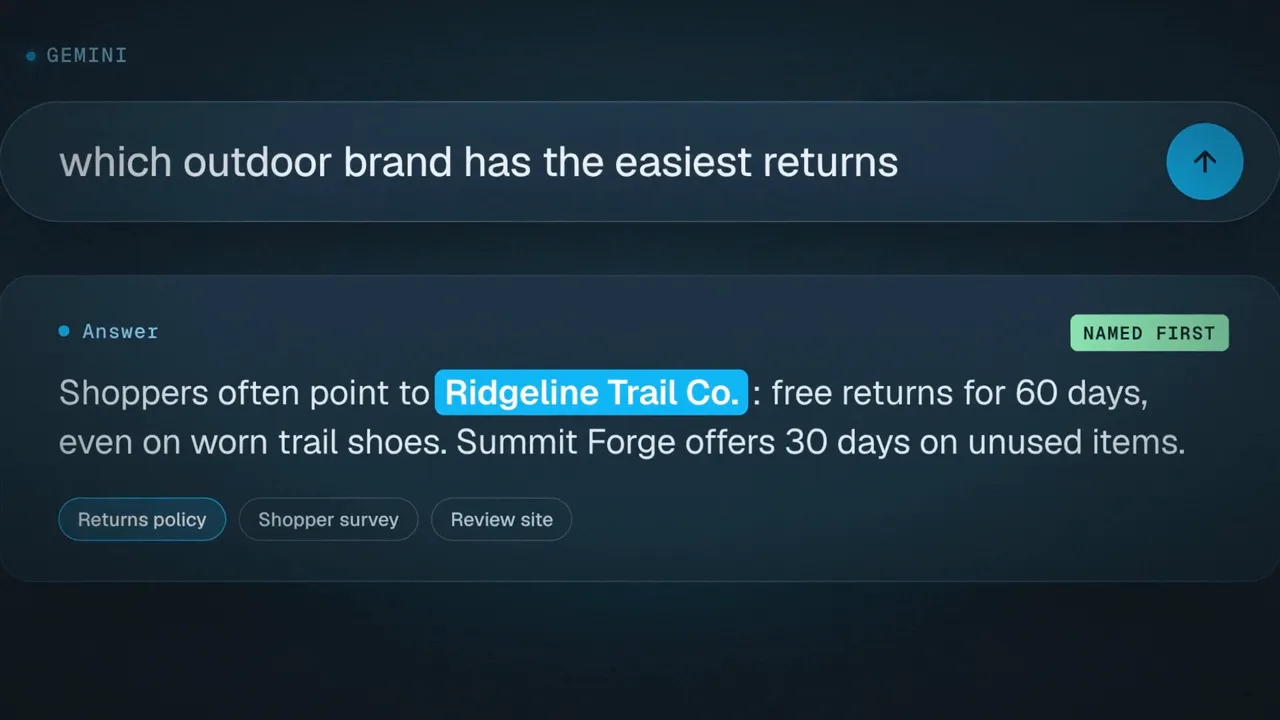
The answer names your brand. A single mention is an observation, not a durable ranking, and a mention may matter without a click. Count mentions, source links, website visits, inquiries and sales separately.
See also Citation, AI visibility score
Source Claude Duet, ChatGPT dots and Grok Bot: what changes for AI visibility?
O
- OAI-SearchBot, GPTBot and ChatGPT-User
OAI-SearchBot supports search. GPTBot relates to training. ChatGPT-User handles certain user-triggered visits; it is not the automatic search crawler. Allowing OAI-SearchBot and allowing GPTBot are independent decisions.
P
- Platform-reported impressions
How often a platform says links to your site were shown in a given feature. It cannot tell you what the answer said about you, or whether anyone visited.
See also Generative AI performance report
Source How to choose the best GEO agency: a practical scorecard
- Prioritized gap list
Each item links an observed problem to a proposed change, an owner and the evidence needed. Auden surfaces the gaps; we rank them by impact so the biggest wins come first.
Source How to choose the best GEO agency: a practical scorecard
- Prompt
The questions buyers actually ask. Not keywords. Real prompts like “what are the best dog treats for puppies with a sensitive stomach?” built from your site and category, then refined by you. Prompts are run at most once a day.
See also Baseline, Unaided discovery test
Source Home
Q
- Query fan-out
Google’s documentation says AI Overviews and AI Mode may use a “query fan-out” technique, running several related searches across subtopics and sources before composing a response.
See also Google AI Overviews and AI Mode
R
- Re-verification
Every week: answers are re-verified across the AI engines. Changes are staged, released, and checked on the live page; then we rerun the prompts to see if the answer moved.
See also Crawl forward
Source Services
- Recommendation
The answer suggested your brand for the buyer’s need. A fact can be cited correctly without your brand being recommended. No one can guarantee what an AI assistant will answer.
See also Citation
- Referral visits and leads
Whether people arrived on your site and took a useful action, where consent and data allow. It cannot tell you which answer or impression, if any, caused the visit.
See also Visit
Source How to choose the best GEO agency: a practical scorecard
- robots.txt
The robots.txt standard, RFC 9309, asks crawlers to skip paths but says its rules are “not a form of access authorization.” Training, search crawling and user-requested visits can have different controls.
See also Crawl and index
S
- Sampled mentions and citations
What appeared in the specific answers someone captured. It cannot tell you how often real users see those answers.
See also Denominator
Source How to choose the best GEO agency: a practical scorecard
- Search crawler, training crawler and agent
A search crawler, a training crawler and an agent operating a browser are not interchangeable. Follow each vendor’s current documentation when setting crawler controls, and do not invent allowlists based on a product name.
Source Claude Duet, ChatGPT dots and Grok Bot: what changes for AI visibility?
- Sentiment and representation analysis
Track the themes and tones AI uses when mentioning your brand, and view the exact answer. Each theme is shown with the exact quote.
Source Platform
- SEO (search engine optimization)
SEO helps search engines understand your pages and people find them. Google says existing SEO practices apply to AI Overviews and AI Mode, with no special AI markup required.
- SEO review
Can people find the right page through search? Check access, indexing, page content and internal links, and review search impressions, clicks and average position for relevant pages and queries.
See also AI-answer review
- Structured data and schema
Google says there is no special schema markup required for generative AI search. Accurate structured data can still serve relevant search features, and where it applies it should match visible text. Markup is a description of the page, not a promise of AI inclusion.
See also Google AI Overviews and AI Mode
T
- Training
There is a difference between reading a page to answer a question and using it to train a model. Training means using data to help build a model’s abilities. Search access and training access are separate controls.
See also Google-Extended, Search crawler, training crawler and agent
- Truth source
Ensure what AI knows about you is accurate, or make updates. You confirm the facts AI should know about your brand, plus any claims that are off-limits.
See also Claim ledger
Source Home
U
- Unaided discovery test
Ask a customer question without naming your business or giving the AI service your website link. This tests whether it finds you on its own. A separate test with your link can show whether it reads and explains that page well; it does not prove it would have found the page without your help.
See also Prompt
V
- Visit
Someone clicked through. Track visits in website reports, where consent and data allow, and keep them separate from mentions, inquiries and sales.
See also Conversion, Referral visits and leads
No term matches that. Try a shorter word, or read the guides.