GEO guides · Fundamentals
What is the difference between an AI citation and an AI recommendation?
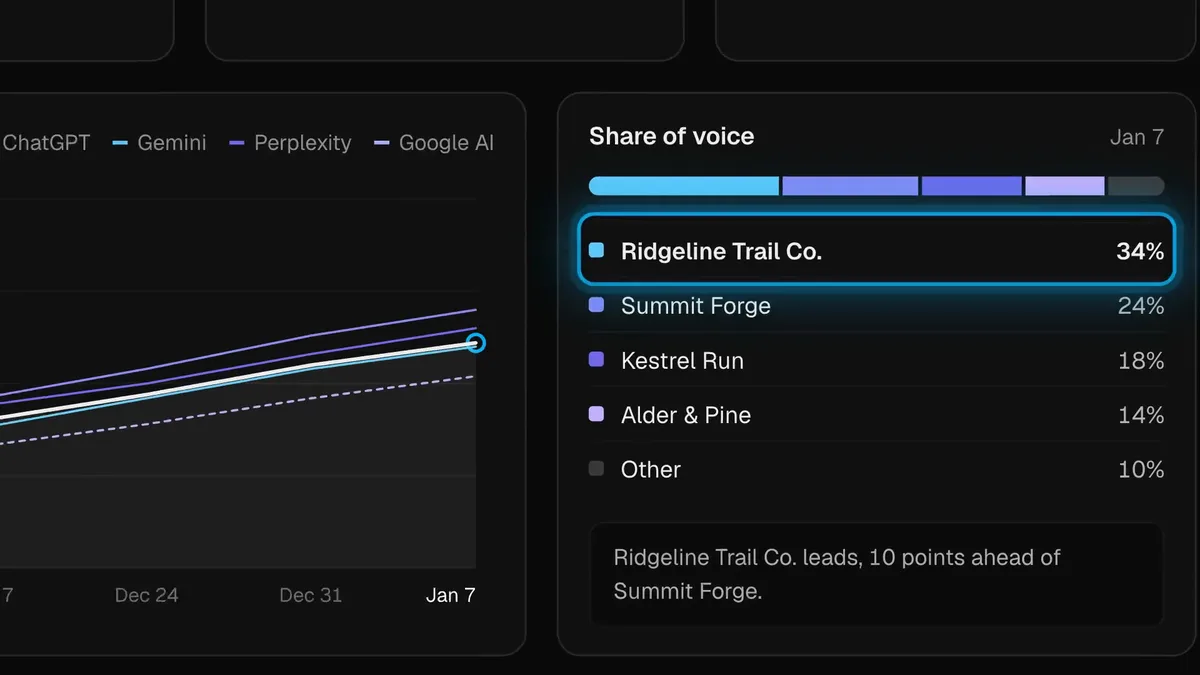
A citation is a link to your page that an assistant shows as a source. A recommendation is your brand named in the answer itself. The two can come apart: a page can be cited while a competitor is the brand the answer names. Measure them as separate numbers.
Last updated November 16, 2026 · By Auden editorial team · 5 min read

Key takeaways
- A citation means your page was linked in an answer. A mention or recommendation means the answer text names your brand.
- Bing says its citation counts do not show placement in an answer or a page’s role in it.1
- An assistant that answers without searching has no sources to link, and it can still name brands.2
- Report three rates for each prompt set: how often you are named, how often you are cited, and how often both happen together.
What is the difference between a citation and a recommendation?
A citation means an assistant listed one of your pages as a source for part of its answer. A mention or recommendation means the answer text names your brand, ideally as a good fit for the question. Citations show whether you were read. Mentions and recommendations show whether you were chosen.
| Outcome | What the buyer sees | What it tells you |
|---|---|---|
| Absent | Neither your brand nor your pages | The assistant did not find or use you. |
| Cited | A link to one of your pages | Your page was used as a source. |
| Mentioned | Your brand name in the answer text | You are part of the answer. |
| Recommended | Your brand named as a fit for the question | You are on the shortlist. |
The four rows are Auden’s working categories for reading an answer. They are not terms the engines use.
How do the engines present citations?
Perplexity says each answer includes numbered citations linking to the original sources. Anthropic says every Claude response that uses web search includes citations, with source links and relevant quotes where appropriate. Google shows supporting links, and Bing reports citations in Copilot and in AI-generated summaries.3451
In Microsoft Copilot Chat there is an additional layer: the citations section also lists the web search queries Copilot sent to Bing.6 Anthropic’s API documentation adds that Claude citations carry a title, a URL and up to 150 characters of cited text.2

Why can a page be cited without the brand being recommended?
A source link supports a statement and does not say which brand the answer prefers. An assistant can cite your buyer’s guide for a definition and then name other brands in its shortlist. Bing says its counts do not show placement, ranking, authority or a page’s role, so a citation count alone cannot show you were chosen.
The reverse can also happen. Claude answers directly, without searching, when a request draws on stable knowledge.2 An answer with no search has no sources to link, yet it can still name brands from what the model learned.
This is why Auden asks for the answer text as well as the sources. A report that counts only links will miss every answer where you were named without one, and will overstate your position where a link supports a competitor’s claim.
How should you measure each one?
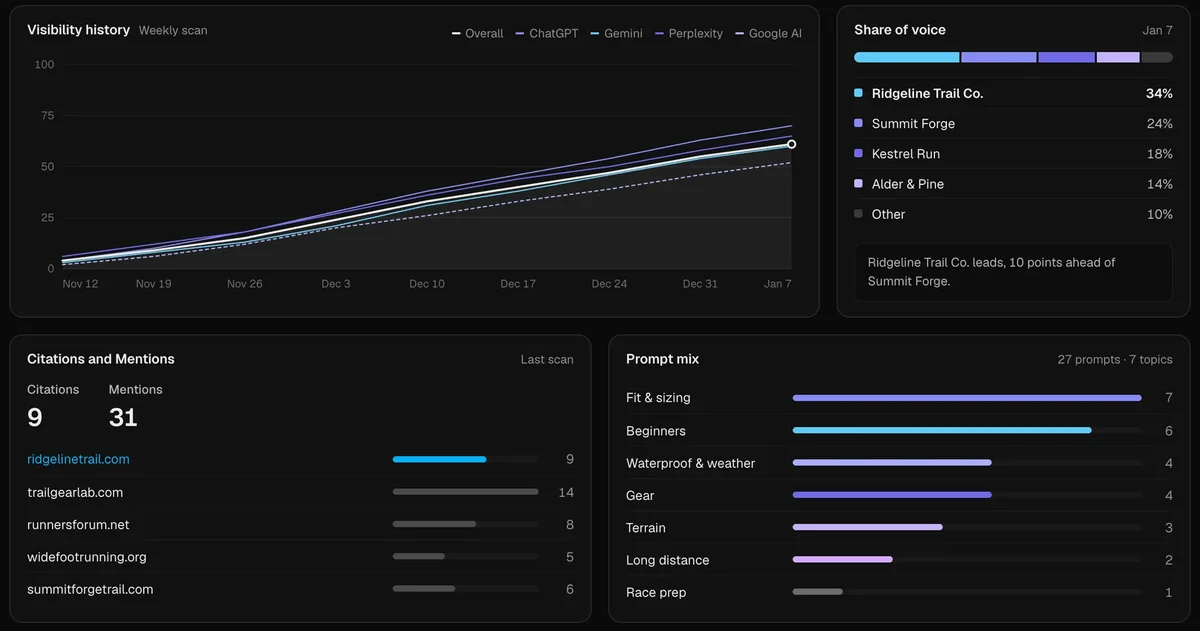
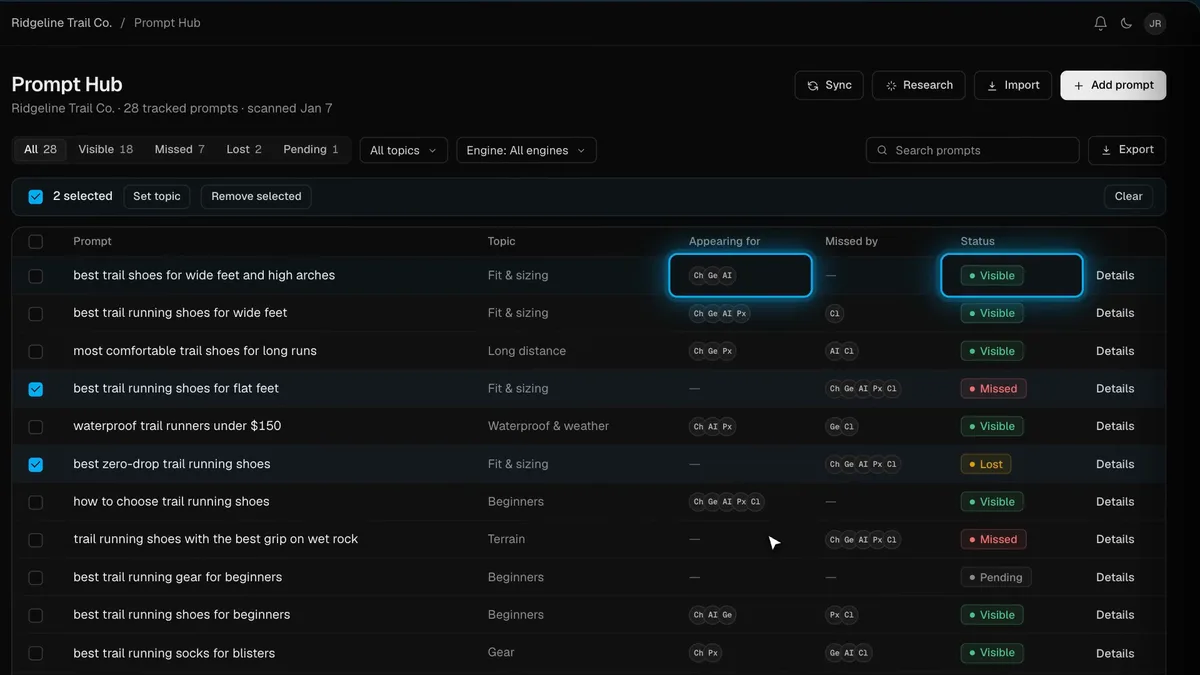
Run a fixed set of buyer prompts, record every brand each answer names, then record every page it cites, and repeat on a schedule. Report separate numbers: how often you are named, how often you are cited, and how often both happen in the same answer. Compare each against named competitors.
- Write the prompts from real buyer language. The prompt tracking guide shows how.
- Run each prompt on each engine you care about and save the full answer with the date.
- For every answer, list the brands named and the URLs cited.
- Calculate the three rates for you and for each competitor.
- Look at the answers where a competitor is named and you are cited. These show a page that is read but not persuasive for that question.
What improves each outcome?
Both start with access: the engine’s crawler must be allowed in and the page must be indexed. After that, Microsoft recommends clear headings, tables and FAQ sections, claims supported by examples, data and sources, current content, and consistent descriptions of the same entities across text, images and video.
That list is from Microsoft’s guidance for pages cited in Copilot and Bing AI answers.1 Google gives parallel advice: original content with a distinct point of view, organized with clear sections and headings.7
Recommendations also depend on what the answer can verify about you elsewhere. Keep your own pages, profiles and listings telling the same facts, so a wrong detail on one site does not contradict the right one on yours. The fixing wrong answers guide covers what to do when it does.
Questions people ask
Is a citation as good as a recommendation?
It depends on the question. A citation shows you were read and may bring a click. A recommendation puts your name in front of the buyer. Track both and look at which prompts produce one without the other.
Do all engines show citations?
Does a higher citation count mean a better position in the answer?
Not necessarily. Bing says citation counts do not show placement or a page’s role in an answer, and that they show how often a page is cited, not its importance.1
Sources
Every statement about how an engine, crawler, file or schema works comes from the pages below, which we read on November 16, 2026. Vendors change these pages, so check the originals before you act.
- 1Bing Webmaster BlogIntroducing AI Performance in Bing Webmaster Tools Public Preview (February 10, 2026)blogs.bing.com/webmaster/February-2026/Introducing-AI-Performance-in-Bing-Webmaster-Tools-Public-Preview · accessed November 16, 2026
- 2Claude Platform DocsWeb search toolplatform.claude.com/docs/en/agents-and-tools/tool-use/web-search-tool · accessed November 16, 2026
- 3Perplexity Help CenterHow does Perplexity work?www.perplexity.ai/help-center/en/articles/10352895-how-does-perplexity-work · accessed November 16, 2026
- 4Claude Help CenterEnable and use web searchsupport.claude.com/en/articles/10684626-enable-and-use-web-search · accessed November 16, 2026
- 5Google Search CentralAI features and your websitedevelopers.google.com/search/docs/appearance/ai-features · accessed November 16, 2026
- 6Microsoft LearnData, privacy, and security for web search in Microsoft Copilot and Microsoft Copilot Chatlearn.microsoft.com/en-us/copilot/microsoft-365/manage-public-web-access · accessed November 16, 2026
- 7Google Search CentralOptimizing your website for generative AI features on Google Searchdevelopers.google.com/search/docs/fundamentals/ai-optimization-guide · accessed November 16, 2026
- 8Search Console HelpGenerative AI performance report (Search)support.google.com/webmasters/answer/16984139 · accessed November 16, 2026
Related guides
 What is GEO?A plain definition of GEO and AEO, how they relate to SEO, and what the work involves.5 min readUpdated November 16, 2026
 Prompt trackingHow to choose buyer prompts, structure a stable set, record each run and read the results.5 min readUpdated November 16, 2026Measuring AI search trafficWhat Google Search Console and Bing Webmaster Tools report, what server logs show, and what none of it tells you.4 min readUpdated November 16, 2026
See how AI answers describe your business today.
Auden is a GEO service for US businesses. Run the free visibility check, or talk to the team about a plan.