GEO guides · Playbooks
Do you need structured data for AI search?
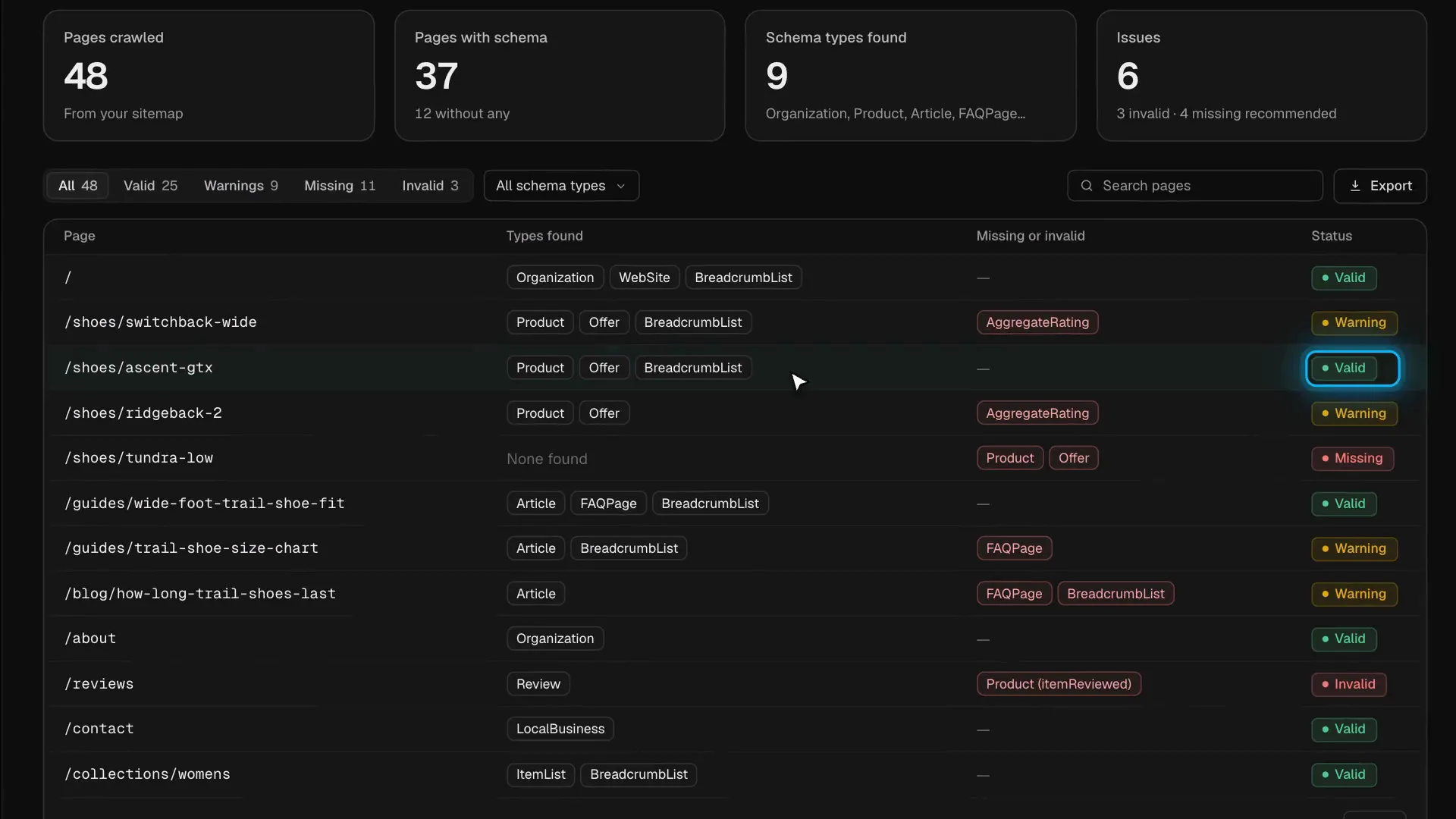
Structured data is code on a page that labels what the page is about. Google says it is not required for its AI features and that there is no special schema.org markup for them. It still gives search systems explicit clues about a page’s meaning, so keep it accurate and matching the visible text.
Last updated November 16, 2026 · By Auden editorial team · 4 min read
Key takeaways
- Google says structured data is not required for generative AI search, and there is no special schema.org markup for it.1
- Markup must describe content that is visible on the page, even when other information is accurate.3
- Google retired its FAQ rich result in 2026. The schema.org FAQPage type still exists.46
- Generate markup from the same data as the visible text so the two cannot drift.
What is structured data?
Google defines structured data as a standardized format for providing information about a page and classifying the page content. It supports JSON-LD, Microdata and RDFa, and recommends JSON-LD if your setup allows it. The markup sits on the page it describes and gives search systems explicit clues about what the page means.
Do AI features need it?
Google says no. Structured data is not required for generative AI search and there is no special schema.org markup to add, but it supports rich result eligibility as part of regular SEO, so keep using it. Microsoft’s advice for Copilot is about page structure: clear headings, tables and FAQ sections.
Google’s AI features guide repeats the point: you do not need AI-specific markup, and structured data should match the visible text on the page.21 The Microsoft recommendation appears in its Bing Webmaster guidance for pages cited in AI answers.7 In practice that means writing the page itself so a reader, and a system extracting from it, can find the answer under the heading that asks the question.

Which markup is still worth adding?
Mark up what the page already shows. For a guide that is an Article with its author and dates. Google lists no required properties for Article and recommends headline, author, datePublished and dateModified. Add only the properties that apply, and describe only information visible to readers.
Google asks you to list each author separately, use Person for people and Organization for organizations, and put only the name in author.name.5 A minimal example:
{
  "@context": "https://schema.org",
  "@type": "Article",
  "headline": "Choosing a tent",
  "author": { "@type": "Organization", "name": "Example Outfitters" },
  "datePublished": "2026-11-16",
  "dateModified": "2026-11-16"
}
Questions and answers need a separate note. Google removed documentation for its FAQ rich result on June 15, 2026 and says the feature no longer shows in Search, starting May 7, 2026.4 Schema.org still defines FAQPage as a web page presenting frequently asked questions.6 Marking up a visible FAQ remains valid, but it no longer earns a Google FAQ result, so do not add one for that reason.
How do you add and test it?
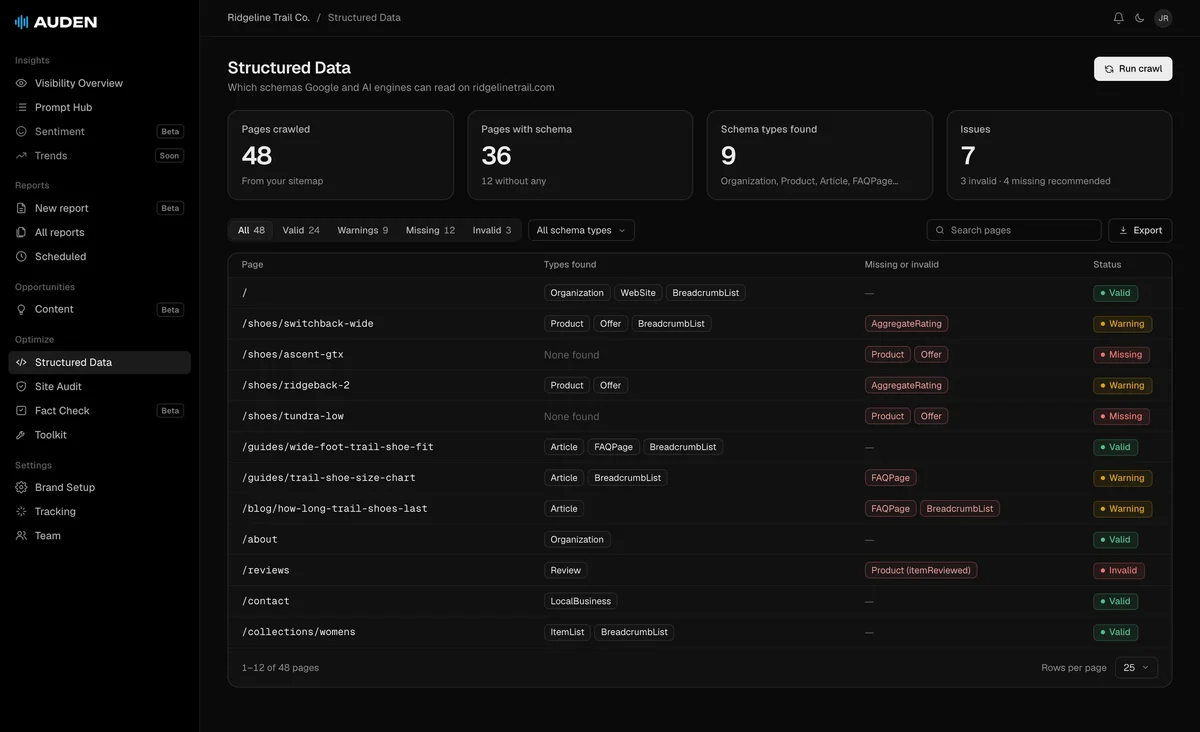
Choose JSON-LD, generate it from the same source as the visible content, validate it with Google’s Rich Results Test, and check the rich result status reports in Search Console after launch. Re-test after template changes, because a templating or serving error can break markup that was valid when you wrote it.
- Pick the type that describes what the page actually is.
- Build the JSON-LD from the same fields that print the headline, author, dates and questions, so the visible text and the markup change together.
- Run the page through the Rich Results Test.3
- Deploy, then watch the rich result status reports for errors.3
- Re-test whenever a template, plugin or theme update touches the page.
What mistakes should you avoid?
The main one is marking up something the reader cannot see. Google says not to add structured data about information that is not visible to the user, even if the information is accurate. The others follow from it: copying one page’s markup onto another, letting dates go stale, and adding types that do not describe the page.
- Hidden or mismatched content. If the markup says something the page does not, remove it or fix the page.3
- Copied markup. Each page needs its own headline, dates and questions.
- Stale dates. A dateModified that does not match the visible update date misleads readers and systems alike.
- Expecting a feature. Markup is a clue, not a switch, and Google says rich results are not promised.3
Questions people ask
Will schema markup get me cited in AI answers?
Google says structured data is not required for generative AI search and that there is no special schema.org markup for it.1 Nothing in the vendor pages we read says markup raises citation rates.
Does FAQPage markup still matter?
JSON-LD, Microdata or RDFa?
Google supports all three, equally acceptable if valid, and recommends JSON-LD if your setup allows it.3
Who should be the author of an article?
Use Person for a named person and Organization for an organization, and list each author in a separate author field.5
How do I test my markup?
Google recommends the Rich Results Test, and checking rich result status reports in Search Console after deployment.3
Sources
Every statement about how an engine, crawler, file or schema works comes from the pages below, which we read on November 16, 2026. Vendors change these pages, so check the originals before you act.
- 1Google Search CentralOptimizing your website for generative AI features on Google Searchdevelopers.google.com/search/docs/fundamentals/ai-optimization-guide · accessed November 16, 2026
- 2Google Search CentralAI features and your websitedevelopers.google.com/search/docs/appearance/ai-features · accessed November 16, 2026
- 3Google Search CentralIntro to how structured data markup worksdevelopers.google.com/search/docs/appearance/structured-data/intro-structured-data · accessed November 16, 2026
- 4Google Search CentralFAQ structured data (rich result retired in 2026)developers.google.com/search/docs/appearance/structured-data/faqpage · accessed November 16, 2026
- 5Google Search CentralArticle structured datadevelopers.google.com/search/docs/appearance/structured-data/article · accessed November 16, 2026
- 6
- 7Bing Webmaster BlogIntroducing AI Performance in Bing Webmaster Tools Public Preview (February 10, 2026)blogs.bing.com/webmaster/February-2026/Introducing-AI-Performance-in-Bing-Webmaster-Tools-Public-Preview · accessed November 16, 2026
Related guides
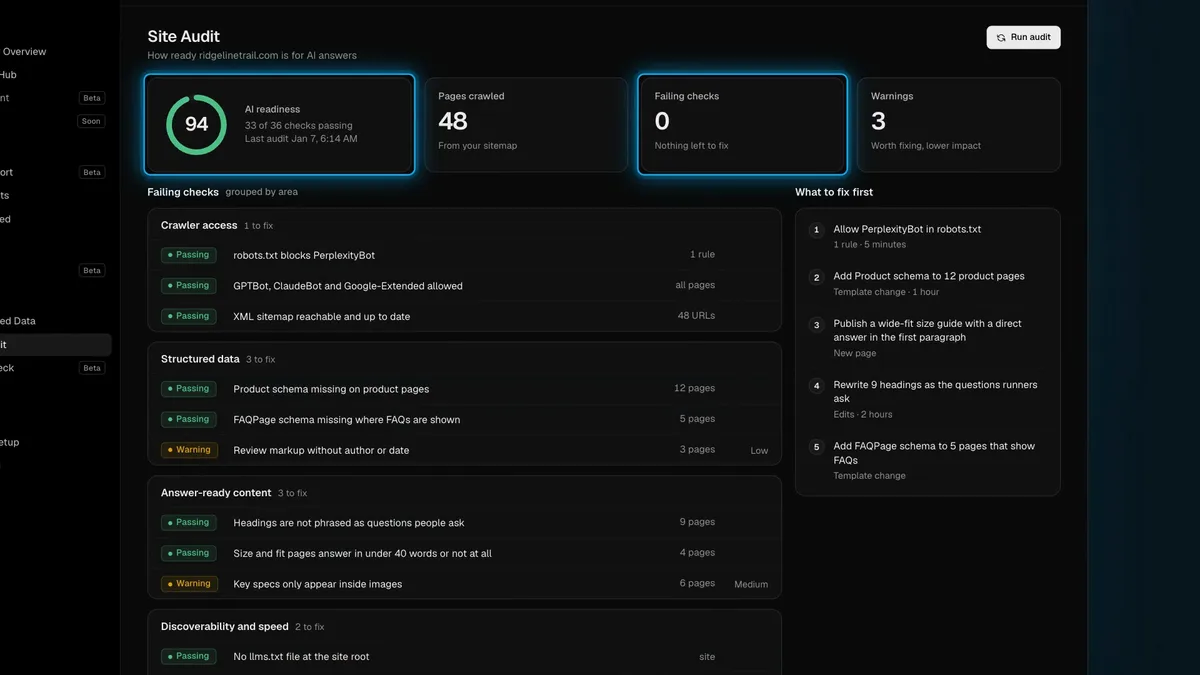 AI crawlers and robots.txtWhich crawlers OpenAI, Anthropic, Perplexity and Google run, what each is for, and how to allow or block them.5 min readUpdated November 16, 2026
 llms.txtWhat the llms.txt proposal contains, what Google says about it, and how to publish one if you choose to.5 min readUpdated November 16, 2026
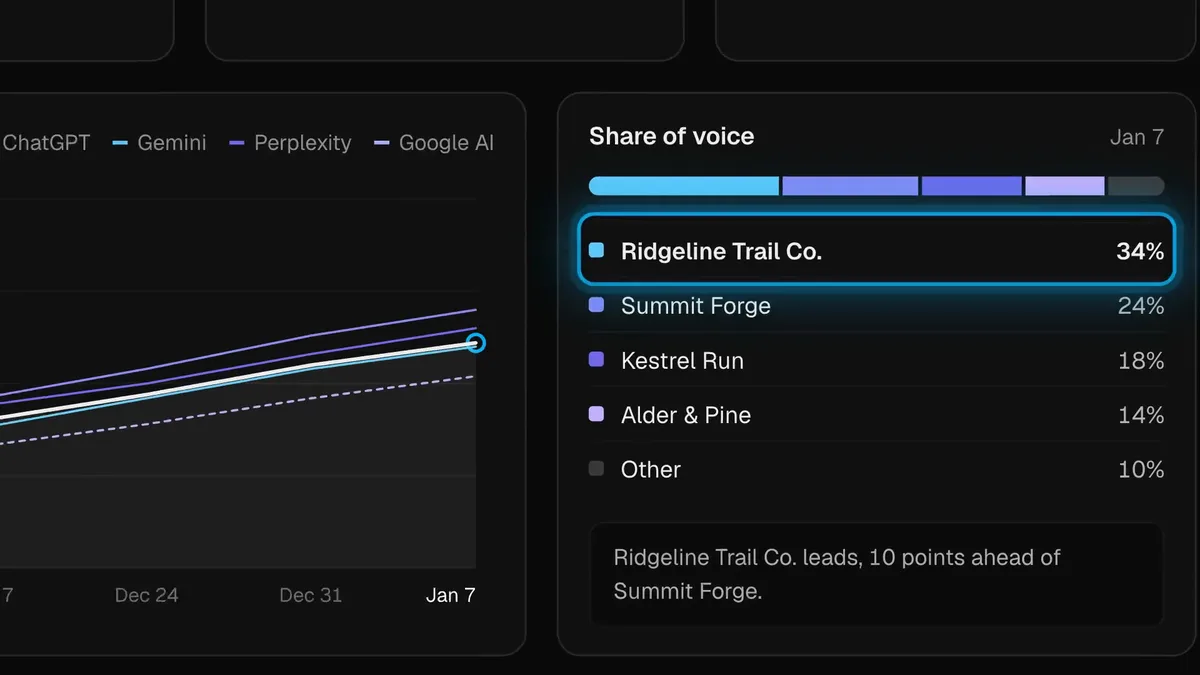 What is GEO?A plain definition of GEO and AEO, how they relate to SEO, and what the work involves.5 min readUpdated November 16, 2026
See how AI answers describe your business today.
Auden is a GEO service for US businesses. Run the free visibility check, or talk to the team about a plan.