GEO guides · Playbooks
How do you measure AI search traffic?
Measure AI search in three layers: what engines report about you, what reaches your site, and what assistants say when you ask. Google Search Console and Bing Webmaster Tools now report AI impressions and citations. For other assistants, server logs and your own prompt checks fill the gaps.
Last updated November 16, 2026 · By Auden editorial team · 4 min read
Key takeaways
- Search Console’s generative AI report counts impressions in AI Overviews and AI Mode, by page, country, date and device.1
- Bing’s AI Performance report counts citations in Copilot and AI summaries, and does not show placement.3
- User-initiated fetchers such as ChatGPT-User, Claude-User and Perplexity-User identify themselves in server logs.456
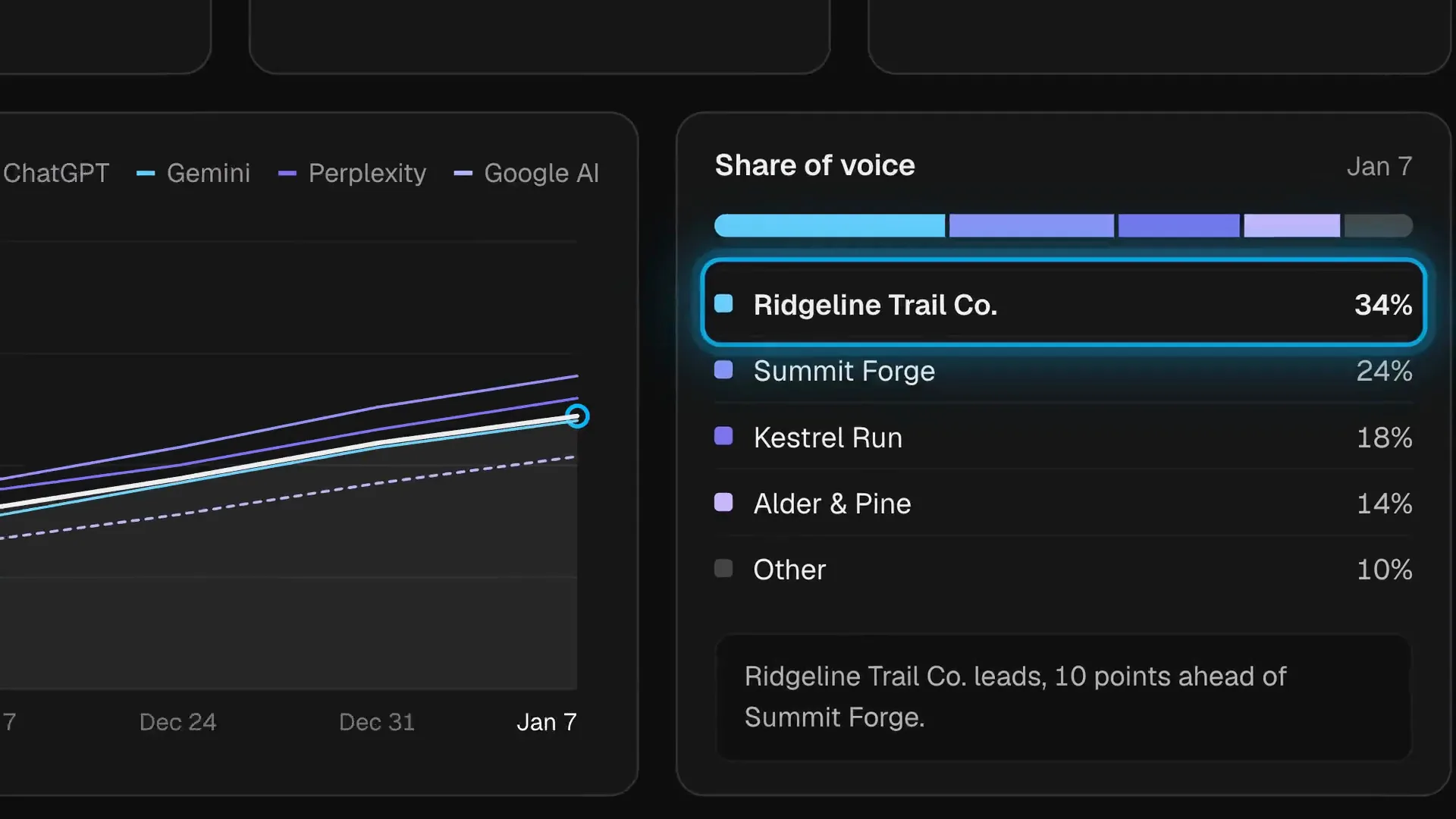
- None of these numbers shows whether you were recommended. Prompt tracking does.
What does Google report about AI features?
Search Console’s generative AI performance report counts impressions: how many times links to your site were shown in a generative AI feature on Google Search. It covers AI Overviews and AI Mode, by page, country, date and device. Google says it rolled the report out to all websites worldwide as of August 31, 2026.
The details matter when you read it. Two results from the same site in one feature count as one impression in the chart. Dates are in Pacific Time. Search Labs experiments are not included, the Search performance report’s 1,000-row limit applies, and the newest data may be preliminary.1 Google also says traffic from AI Overviews and AI Mode is included in the Performance report under the Web search type, and suggests Google Analytics for conversions and engagement.2
What does Bing report about Copilot?
Bing Webmaster Tools added an AI Performance report on February 10, 2026, in public preview. It counts how often your content is a cited source in Copilot, in Bing’s AI summaries and in select partner integrations. Its metrics are total citations, average cited pages, grounding queries and page-level activity.
| Google Search Console | Bing Webmaster Tools | |
|---|---|---|
| What it counts | Impressions of links in generative AI features1 | Citations of your pages as sources3 |
| Where | AI Overviews and AI Mode1 | Copilot, Bing AI summaries, select partners3 |
| Key limit | Deduplicated by property; 1,000-row limit1 | No placement or ranking; grounding queries are a sample3 |
What can server logs and analytics show?
Logs record visits by user-initiated fetchers, such as ChatGPT-User, Claude-User and Perplexity-User, which load a page when a person asks. Their documented user-agent tokens let you count them. Search crawlers such as OAI-SearchBot show that a page is being read for search, which is different from showing that anyone saw it.
OpenAI describes ChatGPT-User as handling actions such as visiting a page when a user asks a question.4 Anthropic describes Claude-User as supporting Claude users who ask questions.5 Perplexity says Perplexity-User may visit a page to help answer and link to it.6
For visitors who click a link inside an answer, look in your analytics for the referrer hostnames you actually see, and group them. Do not assume that a visit without a referrer is not from an assistant, since what is passed depends on the product and the browser.
How do you set the measurement up?
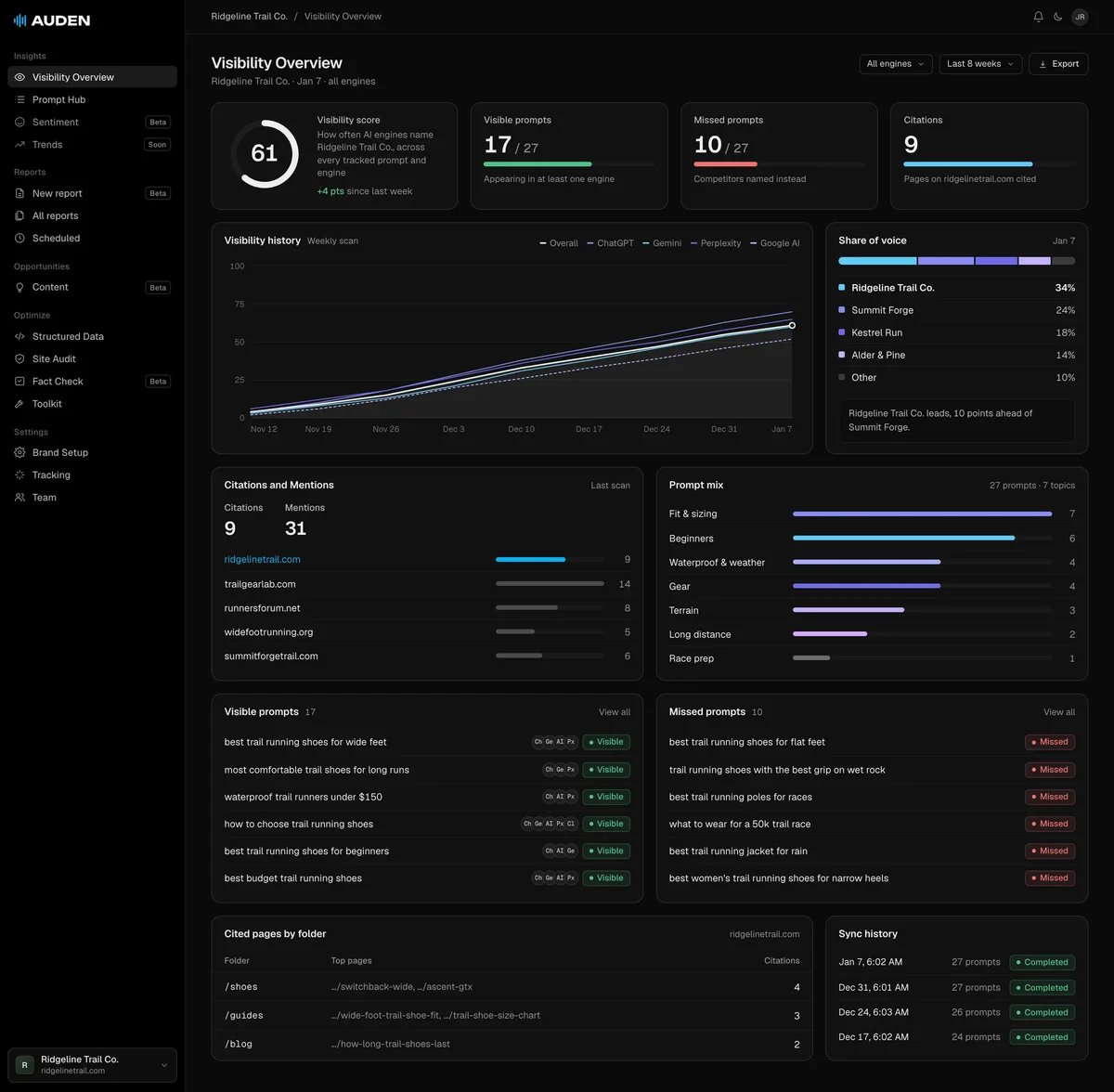
Turn on the reports, record a baseline, add a monthly export and a log filter, and keep a log of changes. Then add a prompt panel for the assistants that report nothing to publishers. The aim is to be able to tie a shift in the numbers to something you changed.
- Verify your site in Search Console and Bing Webmaster Tools, and open the AI reports in each.
- Record the date and the current numbers as your baseline.
- Export monthly. Search Console limits tables to 1,000 rows.1
- Add a log filter for the user-agent tokens in the sections above.
- Run a fixed prompt panel each month. See prompt tracking.
- Keep a change log: new pages, robots.txt edits, rewrites. Annotate it against the charts.
What can these numbers not tell you?
They count appearances, not choices. Bing says citation counts do not show placement, ranking, authority or a page’s role in an answer. Google’s default metric is impressions, not clicks. Neither report says whether your brand was recommended, how it was described or whether the description was right.
That is the job of answer-level checking: citations vs recommendations and fixing wrong answers.31 Be careful with studies that put a percentage on AI traffic. Match the engine, industry, market and date before using one for planning, and do not turn another site’s result into a forecast for yours.
Questions people ask
Does Search Console show clicks from AI Overviews?
Why do the chart and table totals differ?
Google says aggregation differs. The chart aggregates by property, and the table aggregates by property or page depending on the dimension.1
Is there a report for ChatGPT, Claude or Perplexity?
What are Bing grounding queries?
They are the key phrases the AI used when retrieving content it cited. Microsoft says this data is a sample.3
How often should I check?
Monthly is a sensible baseline for the reports, with extra checks after a significant change to your pages or robots.txt. This is Auden’s recommendation, not a vendor requirement.
Sources
Every statement about how an engine, crawler, file or schema works comes from the pages below, which we read on November 16, 2026. Vendors change these pages, so check the originals before you act.
- 1Search Console HelpGenerative AI performance report (Search)support.google.com/webmasters/answer/16984139 · accessed November 16, 2026
- 2Google Search CentralAI features and your websitedevelopers.google.com/search/docs/appearance/ai-features · accessed November 16, 2026
- 3Bing Webmaster BlogIntroducing AI Performance in Bing Webmaster Tools Public Preview (February 10, 2026)blogs.bing.com/webmaster/February-2026/Introducing-AI-Performance-in-Bing-Webmaster-Tools-Public-Preview · accessed November 16, 2026
- 4OpenAI DevelopersOverview of OpenAI crawlers (OAI-SearchBot, GPTBot, ChatGPT-User)developers.openai.com/api/docs/bots · accessed November 16, 2026
- 5Anthropic Privacy CenterDoes Anthropic crawl data from the web, and how can site owners block the crawler?privacy.claude.com/en/articles/8896518-does-anthropic-crawl-data-from-the-web-and-how-can-site-owners-block-the-crawler · accessed November 16, 2026
- 6Perplexity DocsPerplexity crawlers (PerplexityBot and Perplexity-User)docs.perplexity.ai/guides/bots · accessed November 16, 2026
Related guides
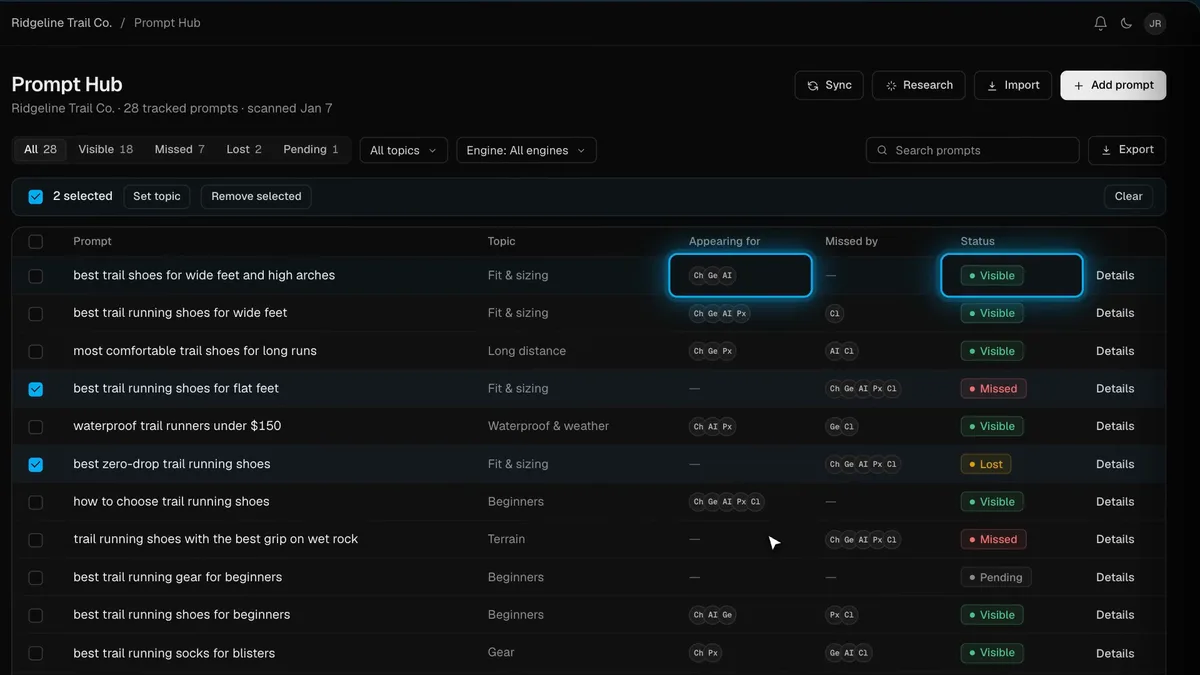 Prompt trackingHow to choose buyer prompts, structure a stable set, record each run and read the results.5 min readUpdated November 16, 2026
 Citations vs recommendationsWhy a page can be cited while a competitor is named, and how to measure each outcome separately.5 min readUpdated November 16, 2026
 Microsoft CopilotHow Copilot builds web searches, where its citations appear, and how to use Bing Webmaster Tools AI Performance.4 min readUpdated November 16, 2026
See how AI answers describe your business today.
Auden is a GEO service for US businesses. Run the free visibility check, or talk to the team about a plan.